Head-to-Head Comparison · 2026
DentaBiome vs Synadentix (2026): Postbiotic Gum Chewable or Mineral Enamel Chewable?
DentaBiome vs Synadentix: a postbiotic gum chewable against a mineral enamel chewable. We read the trials behind both and match each to its buyer.
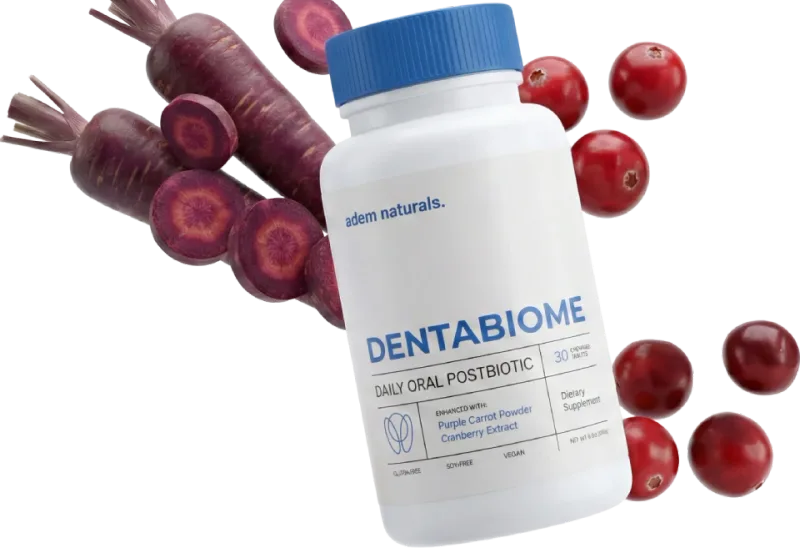
DentaBiome
4.1/5

Synadentix
4.1/5

In 60 seconds
Both are nightly chewables you leave on your teeth, and both hide their amounts in blends. The difference is the target. DentaBiome delivers heat-killed (postbiotic) Lactobacillus preparations, xylitol and cranberry, aimed at the bacteria and the gums, and its closest human evidence comes from specific postbiotic strains its label does not name. Synadentix delivers microcrystalline hydroxyapatite, lactoferrin, lactoperoxidase, cranberry and zinc, aimed at enamel and breath, and its lead ingredient matched fluoride toothpaste in an 18-month adult trial, though in toothpaste form. Synadentix has the stronger long-term human data and a 90-day guarantee against DentaBiome's 60.
DentaBiome approach
Berry-flavored chewable. Chew one tablet for about 30 seconds after brushing at night, then no eating or drinking for 20 to 30 minutes. Dual-strain L. plantarum postbiotic complex, L. salivarius postbiotic, L. rhamnosus postbiotic, BioFresh Clean Complex (enzyme blend), xylitol, purple carrot powder, cranberry extract. No strain designations or amounts disclosed.
Synadentix approach
Chewable tablet taken at bedtime after brushing and flossing, with no rinsing afterward. Proprietary blend: microcrystalline hydroxyapatite, lactoferrin, lactoperoxidase, cranberry extract (A-type PACs), berberine, zinc citrate, guava fruit powder. No amounts disclosed.
The 60-Second Honest Take
At first glance these look like the same product: a chewable you take at night, after brushing, and leave on your teeth. Read the labels and they are close to opposites. DentaBiome works on the bacteria side. Its core is heat-killed, or postbiotic, Lactobacillus. Because nothing in the tablet is alive, nothing has to survive saliva, heat or shelf time. Synadentix works on the mineral side. Its core is microcrystalline hydroxyapatite, the mineral that makes up most of tooth enamel, supported by milk proteins and zinc. Both ideas have human trials behind them. Both products stop short of telling you how much of anything is in a tablet, and neither has been tested as a finished product. So the practical questions are which problem you want to address, and which evidence base holds up better. On the second question Synadentix is ahead, which is why it is listed above DentaBiome in our best oral health supplements roundup.
What DentaBiome Gets Right
The postbiotic premise has direct human support. In a 2016 randomized, double-blind trial in Oral Health & Preventive Dentistry (pubmed.ncbi.nlm.nih.gov/27175447), 39 patients in a periodontal maintenance program took a capsule with 10 mg of heat-killed Lactobacillus plantarum L-137 or a placebo every day for 12 weeks. Both groups improved with their regular dental visits. But at teeth with pockets of 4 mm or deeper, the postbiotic group saw a significantly greater reduction in pocket depth. Because the bacteria were not alive, the result cannot come from colonization, which is exactly DentaBiome's argument for its format. A second postbiotic trial points the same way. In a 2023 placebo-controlled trial in the Journal of Oral Microbiology (pubmed.ncbi.nlm.nih.gov/37649969), healthy adults took tablets with heat-killed Ligilactobacillus salivarius CP3365 every day for eight weeks. Compared with placebo, the tablets significantly held back increases in plaque, bleeding on probing and pocket depth. The strain was prepared by the company that employs most of the authors, which is worth knowing. Cranberry is a sensible inclusion. In a 2010 study in Caries Research (pubmed.ncbi.nlm.nih.gov/20234135), purified cranberry proanthocyanidins reduced Streptococcus mutans biofilm on a tooth-like surface and lowered cavity development in rats. That is lab and animal work, but the mechanism suits a product that sits on the teeth. Synadentix includes cranberry too, so this point does not separate them.
Where DentaBiome Falls Short
The strains in the trials are not the strains on the label. L-137 and CP3365 are specific, named strains. DentaBiome lists L. plantarum, L. salivarius and L. rhamnosus without strain designations. Results in this field are strain-specific, so the trials support the postbiotic idea, not necessarily this tablet. Nothing is dosed on the label. The L-137 trial used 10 mg a day. DentaBiome does not say how much of any postbiotic, enzyme or xylitol a tablet contains, and its BioFresh Clean Complex is not broken down at all. Xylitol's evidence here is weaker than its reputation. In a 2010 double-blind trial in Special Care in Dentistry (pubmed.ncbi.nlm.nih.gov/20415801), adults with high levels of mutans streptococci chewed xylitol gum three times a day, for 4.3 g of xylitol daily, over three months. Levels trended lower than in a group that used nothing, but the difference was not statistically significant. One chewable a day is a much smaller and less frequent exposure than that. The guarantee is the shorter one. DentaBiome offers 60 days, and the 2-bottle order pays shipping. One practical warning from our review: xylitol is dangerous to dogs, so store the bottle well out of reach.
What Synadentix Gets Right
Its lead ingredient has the best long-term human data in this comparison. In an 18-month randomized trial in Frontiers in Public Health (pubmed.ncbi.nlm.nih.gov/37533523), 189 adults used either a fluoride-free hydroxyapatite toothpaste or a 1,450 ppm fluoride toothpaste. Among those who finished, 89.3% of the hydroxyapatite group had no increase in decayed, missing or filled surfaces, compared with 87.4% on fluoride, which met the test for non-inferiority. A six-month trial in 150 orthodontic patients (pubmed.ncbi.nlm.nih.gov/30701704) found early enamel changes in 56.8% of the hydroxyapatite group and 60.9% of the fluoride group, with no significant difference. Its milk proteins have a measured effect on breath. A 2016 crossover trial in BMC Oral Health (pubmed.ncbi.nlm.nih.gov/27001471) gave 39 adults with bad breath a single tablet containing 20 mg of lactoferrin, 2.6 mg of lactoperoxidase and 2.6 mg of glucose oxidase. Ten minutes later, sulfur compounds were significantly lower than after placebo. Zinc and hydroxyapatite together have toothpaste data. A 2024 double-blind trial in Clinical Oral Investigations (pubmed.ncbi.nlm.nih.gov/39572408) found that a fluoride toothpaste with zinc citrate, hydroxyapatite and potassium citrate cut salivary Streptococcus mutans by a larger percentage than fluoride alone over four weeks, and users reported less sensitivity. Plaque and gum scores did not differ. It gives you 90 days. That is enough time to fit a dental cleaning into the trial period and ask a hygienist what they see.
Where Synadentix Falls Short
The best evidence is in a different format. Every hydroxyapatite and zinc result above came from toothpaste used daily. Synadentix is a once-nightly chewable with undisclosed amounts, and no published trial has tested that. Lactoferrin did little for gums over 12 weeks. In a 2011 trial in the International Journal of Dentistry (pubmed.ncbi.nlm.nih.gov/21747858), 72 adults with existing gum problems took lactoferrin and lactoperoxidase tablets or control tablets daily for 12 weeks. Gum measurements and bacteria counts were comparable between the groups, and the authors said the effect might be weak. The breath result above was a 10-minute effect in a study run by the ingredient maker. Two ingredients have no human oral data we could cite. We found none for berberine or guava powder in this kind of use. It is not for everyone. Lactoferrin and lactoperoxidase come from milk, so people with a dairy protein allergy should skip it.
How to Decide, and How to Test Either One
Choose DentaBiome if: • Bleeding when you floss is your main concern • A live oral probiotic has already let you down and you want to try a non-living approach • You have no dogs at home, or you can store the bottle securely Choose Synadentix if: • Enamel, sensitivity to cold, or morning breath are your main concerns • You want a fluoride-free extra step that does not replace your toothpaste • You have no dairy protein allergy and want the longer 90-day window For either one: keep brushing and flossing exactly as you do now, pick one thing to track (bleeding when you floss, a 1-to-10 sensitivity score, or morning breath), and book a cleaning near the end of the guarantee window. If you have pain, swelling or loose teeth, see a dentist before trying any supplement. Offers change, so check current prices using the buttons on this page; we may earn a commission if you buy through them. Our guides to the oral microbiome and health and whether Synadentix works go deeper. This comparison is for education only and is not medical or dental advice. If you are weighing the postbiotic format against the original live-culture formula instead, see DentaBiome vs ProDentim.
Quick Verdict
Choose DentaBiome if you want:
- ✓Anyone whose gums bleed when brushing or flossing despite a decent routine
- ✓People who have tried live oral probiotics and were unconvinced
- ✓Adults who want a supplement that stays in the mouth rather than one they swallow
May not be ideal for:
Anyone with active tooth pain, an abscess or advanced periodontitis — that is a dentist visit, not a supplement
Choose Synadentix if you want:
- ✓Adults 45+ experiencing tooth sensitivity or weakening enamel
- ✓People with receding or inflamed gums seeking natural support
- ✓Anyone interested in oral microbiome health beyond basic hygiene
May not be ideal for:
People under 18 without parental/dental guidance
Side-by-Side Comparison
| Feature | DentaBiome | Synadentix |
|---|---|---|
| Our Rating | 4.1/5 | 4.1/5 |
| Starting Price | $49 | $49 |
| Guarantee | 60-day money-back | 90-day money-back guarantee |
| Key Ingredients | 7 active ingredients | 7 active ingredients |
| Best For | Anyone whose gums bleed when brushing or flossing despite a decent routine | Adults 45+ experiencing tooth sensitivity or weakening enamel |
Pros & Cons
DentaBiome
Pros
- ✓The postbiotic format genuinely solves the viability problem that undermines most live oral probiotics
- ✓Heat-killed L. plantarum L-137 has a randomized placebo-controlled trial showing reduced periodontal probing depth
- ✓The FabM mechanism traces to a real, citable paper rather than to invented biology
- ✓Chewable delivery keeps actives in contact with teeth and the gum line instead of sending them to the stomach
- ✓Xylitol and cranberry proanthocyanidins both have solid mechanistic and, for xylitol, randomized human support
Cons
- ✗Proprietary blend: no strain designations, no milligram amounts, no way to know if it matches the studied preparations
- ✗The headline percentages — 99.9% eradication, 47% in 24 hours, 60% at 8 days — are not sourced to any study we could locate
- ✗One tablet a day delivers far less xylitol exposure than the trials that produced the caries data
- ✗New brand, on the market only since December 2025 — no long refund or service track record to judge
Synadentix
Pros
- ✓Hydroxyapatite is used in Japan as a proven fluoride alternative for enamel repair
- ✓Targets the oral microbiome — addresses root cause rather than just symptoms
- ✓Chewable tablet delivers ingredients directly to teeth and gums
- ✓Lactoferrin and cranberry extract are backed by dental research
- ✓Nightly use works with your body's overnight repair processes
Cons
- ✗Only available on the official website — not in pharmacies or stores
- ✗Premium pricing — $49-$79 per bottle depending on package
- ✗Contains dairy-derived proteins — not suitable for dairy allergies
- ✗Results take 4-8 weeks for gum and enamel changes to become noticeable
Pricing Comparison
DentaBiome
Synadentix
Frequently Asked Questions
Which is better, DentaBiome or Synadentix?
Both DentaBiome (rated 4.1/5) and Synadentix (rated 4.1/5) are solid oral health supplements. DentaBiome is best for Anyone whose gums bleed when brushing or flossing despite a decent routine, while Synadentix excels at Adults 45+ experiencing tooth sensitivity or weakening enamel. The best choice depends on your specific goals and preferences.
What is the price difference between DentaBiome and Synadentix?
DentaBiome starts at $49 per bottle while Synadentix starts at $49 per bottle. Both offer multi-bottle discounts that reduce the per-unit cost. DentaBiome comes with a 60-day money-back guarantee and Synadentix offers a 90-day money-back guarantee guarantee.
Which has better ingredients, DentaBiome or Synadentix?
DentaBiome features 7 key ingredients while Synadentix contains 7 active compounds. Both formulas are manufactured in FDA-registered, GMP-certified facilities. The ingredient profiles target oral health from different angles, so the better formula depends on which specific benefits matter most to you.
Can I take DentaBiome and Synadentix together?
We recommend choosing one supplement at a time so you can accurately assess its effects. Taking both simultaneously makes it difficult to determine which product is contributing to your results. If one doesn't meet your needs, you can switch to the other. Always consult your healthcare provider before combining supplements.
Final Verdict
Synadentix gets the edge. Neither chewable has been tested as a finished product, and both hide their amounts. But Synadentix's lead ingredient, hydroxyapatite, matched fluoride toothpaste over 18 months in adults, and its lactoferrin blend lowered bad-breath compounds in a controlled test. DentaBiome's best trials used named postbiotic strains that its label does not list, and the xylitol trial behind its sweetener did not reach significance. Synadentix also offers 90 days to DentaBiome's 60. Choose DentaBiome if bleeding gums, rather than enamel, is your main concern and you want to test the postbiotic approach. With either one, keep brushing and flossing, track one simple sign, and let your hygienist be the judge.