Head-to-Head Comparison · 2026
DentaBiome vs ProDentim (2026): Postbiotics or Live Cultures?
DentaBiome ships heat-killed postbiotics; ProDentim ships 3.5 billion CFU of live oral probiotics. One of those formats has a viability problem and the other has a track record. We compare the trials, the labels and the trade-offs.
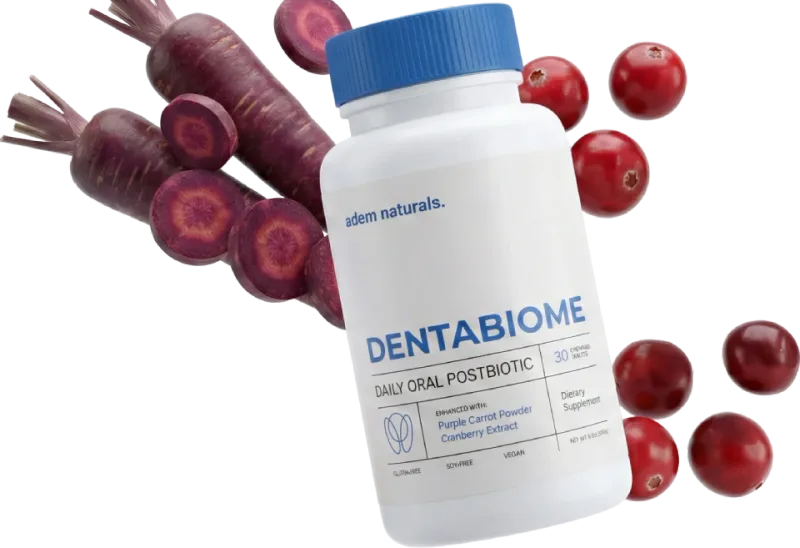
DentaBiome
4.1/5
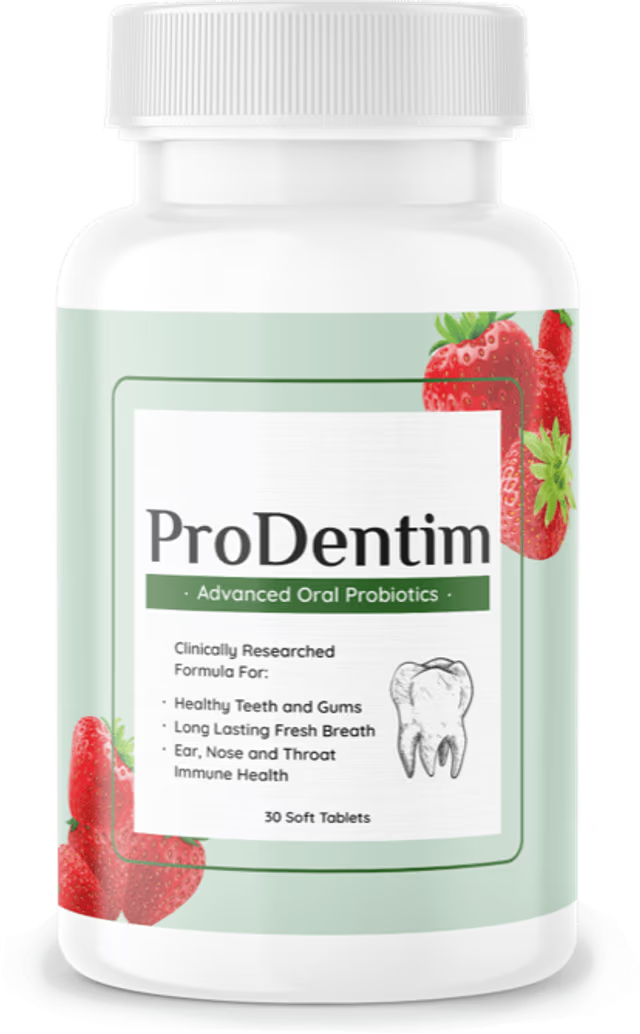
ProDentim
4.2/5

In 60 seconds
This is a genuine format disagreement, not a marketing one. ProDentim ships live probiotic cultures — 3.5 billion CFU across five strains, including BLIS K-12 and BLIS M-18, two of the best-characterised oral strains in the literature — and accepts the viability problem that comes with anything alive. DentaBiome ships heat-killed postbiotic preparations of three Lactobacillus species, which cannot degrade or be destroyed by saliva because they are not alive, and accepts that it must forgo colonization entirely. Both approaches have randomized human trials behind them. ProDentim names its strains; DentaBiome does not, and that is what separates them here.
DentaBiome approach
Three heat-killed postbiotic preparations (dual-strain L. plantarum complex, L. salivarius, L. rhamnosus) plus an unnamed BioFresh enzyme blend, xylitol, purple carrot powder and cranberry extract. Berry Frost chewable tablet, 30 per bottle. Proprietary blend — no strains, no amounts.
ProDentim approach
3.5 billion CFU across five named live strains including BLIS K-12 (Streptococcus salivarius K12), BLIS M-18 and Lactobacillus reuteri, plus inulin, malic acid, tricalcium phosphate and peppermint. Dissolvable tablet. Strains are named, which allows the trial literature to be checked.
The 60-Second Honest Take
Almost every product in this category ships live bacteria and hopes for the best. DentaBiome is the first mainstream oral supplement we have reviewed that argues the live part is the problem. That argument deserves a fair hearing, because it is not wrong. Live cultures degrade with heat, light, oxygen and time. Most are destroyed by salivary lysozyme within minutes of entering the mouth. And the CFU figure printed on a probiotic bottle is a count at manufacture, not a count at the moment you take it — a distinction the category rarely volunteers. DentaBiome's answer is to heat-kill the bacteria and ship what remains: cell-wall fragments and metabolites that still interact with tissue and cannot possibly die. Nothing to protect, nothing to keep alive, no gap between the label and the bottle. ProDentim's answer is that colonization is the point. If beneficial strains actually establish themselves in the oral biofilm, they keep working after the tablet is gone — and ProDentim names the strains, so you can go read the trials on BLIS K-12 and decide for yourself. Both positions are defensible. Only one of these products lets you verify what you are getting. ProDentim names five strains. DentaBiome names three species and no strains, which matters more than it sounds, because probiotic and postbiotic effects are strain-specific rather than species-specific.
What DentaBiome Gets Right
The viability argument is the strongest structural case any product in this category has made. It is not a rhetorical device; it identifies a real weakness that the live-culture camp does not have a clean answer to. The postbiotic concept has direct human trial support in periodontal health. In a randomized, double-blind, placebo-controlled trial, 39 patients undergoing supportive periodontal therapy took a capsule containing 10 mg of heat-killed Lactobacillus plantarum L-137 daily for 12 weeks; daily intake was associated with reduced periodontal probing depth. Because the cells were heat-inactivated, that result cannot be explained by colonization — which is precisely the mechanism DentaBiome relies on. A 2023 double-blind randomized trial of heat-killed Ligilactobacillus salivarius CP3365, published in the Journal of Oral Microbiology, found daily tablets inhibited increases in periodontal parameters over 8 weeks. The mechanism the sales page names is real. DentaBiome is marketed around FabM, an enzyme in Streptococcus mutans. Fozo and Quivey established in the Journal of Bacteriology in 2004 that the fabM gene product synthesizes the monounsaturated fatty acids S. mutans needs to tolerate acid, and that knocking it out leaves the bacterium extremely acid-sensitive with reduced virulence in a rat caries model. In a category where 'root causes' are usually invented, this one traces to a citable paper. The chewable format is the right delivery route for what is in it. Xylitol's caries evidence comes from chewing trials, and the cranberry proanthocyanidins need contact with tooth surfaces to interfere with the glucosyltransferases that build plaque. And the guarantee terms are unusually buyer-friendly: 60 days with empty bottles accepted, administered by ClickBank rather than by the brand.
Where DentaBiome Falls Short
Two gaps, and the first is the one that matters. No strain designations. The trial evidence above is for L. plantarum L-137 and Ligilactobacillus salivarius CP3365 specifically. Those suffixes are not decoration — probiotic and postbiotic effects are strain-specific, and a different L. plantarum strain is a different biological agent. DentaBiome's label names species. It does not name strains, and it does not name amounts. So the trials support the concept the product is built on while telling you nothing about the product itself. ProDentim, by naming BLIS K-12 and BLIS M-18, does not have this problem. Percentages that lead nowhere. The sales page attaches specific figures to the formula: 99.9% eradication of S. mutans, 47% fewer harmful bacteria in 24 hours, 60% reduction after 8 days, 36%+ inhibition of gum disease bacteria. We looked for the underlying studies and could not locate any of them. That does not mean the product does nothing — the ingredient concepts have genuine support — but the numbers should be read as advertising rather than as results. Two smaller points. The FabM link is asserted, not demonstrated: no published study shows that chewing a postbiotic tablet inhibits FabM activity in a human mouth. And the brand is new, appearing on the ClickBank marketplace in December 2025, which is not long enough to judge a company on how it handles service or refunds. Our full DentaBiome review covers both.
What ProDentim Gets Right
ProDentim is the established formula in this category on this site, and it holds that position for reasons that survive scrutiny. Named strains with their own literature. BLIS K-12 is Streptococcus salivarius K12, one of the most-studied oral strains in existence, with published work on volatile sulfur compounds and halitosis. BLIS M-18 has its own body of research on plaque and enamel. Lactobacillus reuteri has multiple randomized trials in gingival inflammation, including a 2012 trial in 40 gingivitis subjects where L. reuteri tablets reduced total anaerobic counts in saliva and P. gingivalis counts in subgingival samples. You can read every one of these and form your own view — a freedom DentaBiome's label does not give you. A stated CFU count. 3.5 billion is a number that can be compared. It carries the viability caveat DentaBiome correctly identifies, but a disclosed and imperfect figure beats no figure at all. Enamel-support minerals in the same tablet. Tricalcium phosphate addresses remineralization, which DentaBiome's formula does not target directly. A 90-day guarantee against DentaBiome's 60, which better matches how long gum changes take to become observable. The honest caveat on ProDentim's side is the one DentaBiome built its pitch around: nobody can tell you how many of those 3.5 billion cells are alive when the tablet reaches your mouth. That is a real weakness, and it is fair for a competitor to name it. Our ProDentim review discusses it directly.
How to Decide, and How to Test Either One
The choice comes down to which trade-off you find easier to live with. Choose DentaBiome if: you have already tried a live oral probiotic and got nothing from it, and the viability question is the reason you suspect why. Or if you simply prefer a chewable to a dissolvable tablet, or want xylitol and cranberry in the mix — neither of which ProDentim leads with. Choose ProDentim if: you want to be able to look up what you are taking. Named strains with published trials are a materially different proposition from unnamed species inside a proprietary blend, and for most buyers that should be the deciding factor. It is also why ProDentim holds the top position in our best oral health supplements roundup. Whichever you pick, test it the same way, because there is one honest endpoint here. Does flossing still draw blood? That is observable, it is not subject to your own judgment the way breath freshness is, and both products' trial evidence points in that direction. Take it at night after brushing — saliva flow drops during sleep, so anything left in the mouth stays in contact for hours rather than minutes. Keep flossing, because plaque is a structured biofilm that has to be disrupted physically no matter what bacteria you add. Give it eight weeks, which is inside DentaBiome's 60-day window and well inside ProDentim's 90. If flossing still draws blood at week eight, request the refund and take the result to your dentist. Persistent bleeding gums are a clinical finding, not a supplement problem.
The Verdict, Stated Plainly
ProDentim remains the better default, and it is disclosure rather than format that decides it. DentaBiome has identified a real weakness in the live-probiotic model and answered it with an approach that has randomized human support. That is genuinely more interesting than most product launches in this category. But it then withholds the strain designations that would let a buyer connect its formula to that support, while ProDentim publishes strains you can look up and a CFU count you can compare. When one label can be checked and the other cannot, the checkable one wins. DentaBiome is the better second try. If you have run ProDentim or another live oral probiotic for two months and seen nothing, the viability question is a legitimate hypothesis for why, and DentaBiome tests it directly. The chewable format, the xylitol and the cranberry proanthocyanidins are all reasonable additions, and a 60-day guarantee that accepts empty bottles is a low-risk way to find out. Neither replaces brushing, flossing or a dental appointment, and neither is a treatment for gum disease. Both are worth eight weeks against a single observable question — and if that question still answers 'yes, it bleeds,' the next step is a dentist rather than a third bottle.
Quick Verdict
Choose DentaBiome if you want:
- ✓Anyone whose gums bleed when brushing or flossing despite a decent routine
- ✓People who have tried live oral probiotics and were unconvinced
- ✓Adults who want a supplement that stays in the mouth rather than one they swallow
May not be ideal for:
Anyone with active tooth pain, an abscess or advanced periodontitis — that is a dentist visit, not a supplement
Choose ProDentim if you want:
- ✓Adults dealing with recurring gum sensitivity or occasional bleeding
- ✓People who want to freshen breath without relying on alcohol-based mouthwashes
- ✓Those looking for a natural supplement to complement their dental routine
May not be ideal for:
Children under 18 without dentist approval
Side-by-Side Comparison
| Feature | DentaBiome | ProDentim |
|---|---|---|
| Our Rating | 4.1/5 | 4.2/5 |
| Starting Price | $49 | $49 |
| Guarantee | 60-day money-back | 60-day money-back |
| Key Ingredients | 7 active ingredients | 8 active ingredients |
| Best For | Anyone whose gums bleed when brushing or flossing despite a decent routine | Adults dealing with recurring gum sensitivity or occasional bleeding |
Pros & Cons
DentaBiome
Pros
- ✓The postbiotic format genuinely solves the viability problem that undermines most live oral probiotics
- ✓Heat-killed L. plantarum L-137 has a randomized placebo-controlled trial showing reduced periodontal probing depth
- ✓The FabM mechanism traces to a real, citable paper rather than to invented biology
- ✓Chewable delivery keeps actives in contact with teeth and the gum line instead of sending them to the stomach
- ✓Xylitol and cranberry proanthocyanidins both have solid mechanistic and, for xylitol, randomized human support
Cons
- ✗Proprietary blend: no strain designations, no milligram amounts, no way to know if it matches the studied preparations
- ✗The headline percentages — 99.9% eradication, 47% in 24 hours, 60% at 8 days — are not sourced to any study we could locate
- ✗One tablet a day delivers far less xylitol exposure than the trials that produced the caries data
- ✗New brand, on the market only since December 2025 — no long refund or service track record to judge
ProDentim
Pros
- ✓Probiotic approach addresses oral health at the microbiome level — not just surface symptoms
- ✓Contains well-researched strains like BLIS K-12, L. Reuteri, and B.lactis BL-04
- ✓Chewable tablet format ensures direct contact with the oral environment
- ✓No harsh chemicals, alcohol, or artificial ingredients
- ✓60-day money-back guarantee lets you try it with minimal risk
Cons
- ✗Only available through the official website — can't pick it up at a pharmacy or store
- ✗Takes 2-4 weeks of daily use before most people notice meaningful changes
- ✗Probiotic viability depends on proper storage — keep away from excessive heat
- ✗Per-bottle cost is higher than basic oral care products, though it serves a different purpose
Pricing Comparison
DentaBiome
ProDentim
Frequently Asked Questions
Which is better, DentaBiome or ProDentim?
Both DentaBiome (rated 4.1/5) and ProDentim (rated 4.2/5) are solid oral health supplements. DentaBiome is best for Anyone whose gums bleed when brushing or flossing despite a decent routine, while ProDentim excels at Adults dealing with recurring gum sensitivity or occasional bleeding. The best choice depends on your specific goals and preferences.
What is the price difference between DentaBiome and ProDentim?
DentaBiome starts at $49 per bottle while ProDentim starts at $49 per bottle. Both offer multi-bottle discounts that reduce the per-unit cost. DentaBiome comes with a 60-day money-back guarantee and ProDentim offers a 60-day money-back guarantee.
Which has better ingredients, DentaBiome or ProDentim?
DentaBiome features 7 key ingredients while ProDentim contains 8 active compounds. Both formulas are manufactured in FDA-registered, GMP-certified facilities. The ingredient profiles target oral health from different angles, so the better formula depends on which specific benefits matter most to you.
Can I take DentaBiome and ProDentim together?
We recommend choosing one supplement at a time so you can accurately assess its effects. Taking both simultaneously makes it difficult to determine which product is contributing to your results. If one doesn't meet your needs, you can switch to the other. Always consult your healthcare provider before combining supplements.
Final Verdict
ProDentim keeps the top spot, and the reason is verifiability rather than format. DentaBiome makes a genuinely strong structural argument — live oral probiotics do have a viability problem, salivary lysozyme does destroy most live cells within minutes, and heat-killed postbiotics do sidestep the issue entirely, with randomized human trials in periodontal health to support the concept. But DentaBiome names species without strains and discloses no amounts, while ProDentim names BLIS K-12, BLIS M-18 and L. reuteri, all of which have published literature a buyer can check, and states 3.5 billion CFU. ProDentim also carries a 90-day guarantee against DentaBiome's 60. Choose DentaBiome if a live probiotic has already failed you and you want to test whether viability was the reason, or if you prefer a chewable with xylitol and cranberry. Test either one against a single observable endpoint — whether flossing still draws blood at week eight — and take a persistent yes to your dentist rather than to a third bottle.