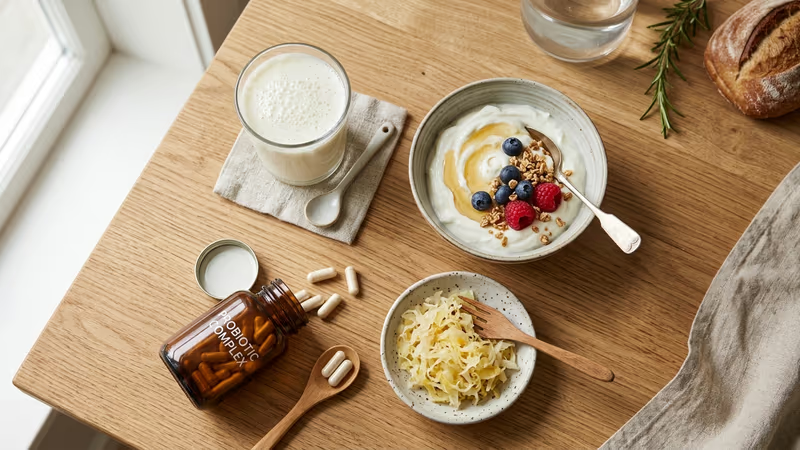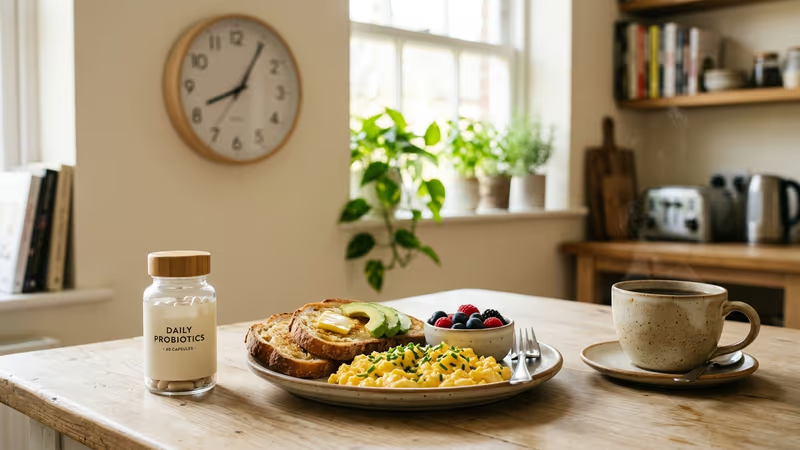

If you've ever stood in your kitchen holding a probiotic capsule and wondered whether to swallow it now or wait until after breakfast, you're not alone. Figuring out when to take probiotics is one of the most common questions we get, and the label is often vague or silent. The short version: timing matters a little, consistency matters a lot, and the strain in your bottle matters more than the clock. Below, we cover what the research shows about the best time to take probiotics, whether food helps, how to handle them alongside antibiotics, how long they take to work, and which side effects are normal.
What You'll Learn
- Whether the time of day you take probiotics changes how well they work
- Should I take probiotics with food? What a lab study on meals and survival found
- Why some strains care about stomach acid and others barely notice it
- How to space probiotics and antibiotics, and how long to keep going afterward
- How long do probiotics take to work, broken down by goal
- Common probiotics side effects, and the rare situations where you should stop
- How to read a CFU label and store your bottle so the bacteria are still alive when you take them
When to Take Probiotics: Does Timing Really Matter?
The whole point of a probiotic is to deliver living bacteria to your intestines. The main obstacle on the way there is your stomach, which sits at a pH of around 1.5 to 3.5 when it's empty. That's strong enough to kill many of the common Lactobacillus and Bifidobacterium strains found in supplements before they reach the small intestine. So the real question behind when to take probiotics is: when is the stomach the least hostile?
The best-known study on this was published by Tompkins and colleagues in 2011 in the journal Beneficial Microbes. The researchers used a laboratory model of the human upper digestive tract to track how a multi-strain probiotic survived when taken at different times around a meal. Survival was best when the capsule was taken with a meal or about 30 minutes before one. Taking it 30 minutes after eating led to the poorest survival, because by then the stomach had emptied and acid levels had climbed back up. Interestingly, the fat content of the meal seemed to matter more than the protein content, likely because fat slows stomach emptying and buffers acid for longer.
One caveat: that was a lab model, not a study of people. But it fits basic physiology, and it's why most gastroenterologists give the same practical advice. If your probiotic is a standard, non-coated capsule of Lactobacillus or Bifidobacterium, take it with or just before a meal that includes some fat, like eggs, yogurt, or a handful of nuts.
Not Every Strain Is Sensitive to Stomach Acid
Here's where the advice changes. Some probiotics are far tougher than others. Saccharomyces boulardii is a beneficial yeast, not a bacterium, and it's naturally resistant to stomach acid and unaffected by antibacterial antibiotics. A 2010 systematic review by McFarland in the World Journal of Gastroenterology looked at 31 randomized trials of S. boulardii in adults and found it was effective across several digestive uses, regardless of meal timing. Spore-forming bacteria such as Bacillus coagulans and Bacillus subtilis are similarly resilient: their spores act like a protective shell that survives acid and only opens up once it reaches the intestines. Enteric-coated or delayed-release capsules are built to do the same job artificially.
For these types, the with-food rule is less important. You can take them on an empty stomach if that's easier to remember, and they generally don't need refrigeration. If your label lists a Bacillus strain, S. boulardii, or says delayed-release, meal timing becomes a minor detail.
Morning vs. Night: Is There a Best Time to Take Probiotics?
No strong clinical trial shows that morning beats night or the other way around. What we have is reasoning from physiology. Taking a probiotic with breakfast pairs it with food, which helps survival, and ties it to a routine most people already keep. Taking it before bed puts it into a stomach that is usually empty and more acidic, though some people argue the slower overnight gut movement gives bacteria more time to settle in. That idea is plausible but not proven.
Our practical suggestion: choose the meal you never skip. If the only way you'll remember is at bedtime, take it then with a small snack that has a little fat, like a spoonful of peanut butter or crackers with cheese. A probiotic you take every night at 10 p.m. will do more for you than the theoretically perfect one you forget three days a week.
How to Take Probiotics With Antibiotics
This is the situation where probiotics have the most consistent evidence. A large meta-analysis by Hempel and colleagues, published in JAMA in 2012, pooled 63 randomized trials with nearly 12,000 participants and found that people taking probiotics alongside antibiotics had a meaningfully lower rate of antibiotic-associated diarrhea, with a number needed to treat of about 13. In plain terms, for every 13 people who took a probiotic during their antibiotic course, one case of diarrhea was avoided.
The timing rule here is simple. Antibiotics kill bacteria, and they don't know the difference between the germ causing your infection and the Lactobacillus in your capsule. So separate them by at least two hours. If you take your antibiotic at 8 a.m. and 8 p.m., take the probiotic around noon or with lunch. S. boulardii, being a yeast, is not affected by antibacterial drugs and can be taken at any time.
Most experts suggest starting the probiotic on day one of the antibiotic, not after, and continuing for one to two weeks after the last antibiotic dose. That said, one well-designed 2018 study by Suez and colleagues in Cell found that a multi-strain probiotic taken after antibiotics actually slowed the return of the participants' own native gut bacteria compared with doing nothing. The study was small and used a specific product, so it's not the final word, but it's a reminder that longer isn't automatically better. A short course during and shortly after antibiotics is well supported; months of use afterward is a personal choice rather than a proven strategy.
Consistency Beats Timing
Most probiotic strains do not permanently move into your gut. Studies that track them show they pass through, remain detectable in stool for a week or two after you stop, and then fade. So the benefit depends on a steady supply. Taking your probiotic at the same time every day, with the same meal, is worth far more than optimizing the hour. Keep the bottle next to something you already use daily, like your coffee maker, until it becomes automatic.
New to probiotics?
If you're still deciding which strains make sense for your goals, start with the basics. Read our full guide to probiotics for gut health for a plain-English look at strains, CFU counts, and what the evidence supports.
Read our full guide to probiotics for gut healthHow Long Do Probiotics Take to Work?
This depends almost entirely on why you're taking them. Here is a realistic timeline based on what the clinical trials measured, not what marketing pages promise.
- Antibiotic-related diarrhea: days. The protective effect in the JAMA meta-analysis showed up within the antibiotic course itself, which is typically 5 to 14 days. This is the fastest and best-supported use.
- Bloating, gas, and IBS-type discomfort: 2 to 4 weeks. A 2018 systematic review by Ford and colleagues in Alimentary Pharmacology and Therapeutics, covering 53 trials and more than 5,500 patients, found that probiotics as a group improved overall IBS symptoms and abdominal pain, though the benefit varied a lot by strain. Most of those trials ran 4 to 12 weeks, and improvements were usually reported by the first month.
- Regularity and constipation: 2 to 4 weeks. A 2014 meta-analysis by Dimidi and colleagues in the American Journal of Clinical Nutrition found that probiotics shortened whole-gut transit time by roughly 12 hours and added about 1.3 bowel movements per week, with the strongest data for Bifidobacterium lactis. Trials again ran about 4 weeks.
- Immune support and skin: 8 to 12 weeks. A 2015 Cochrane review by Hao and colleagues pooled 12 trials with 3,720 participants and found fewer upper respiratory infections and shorter episodes in the probiotic groups, but those studies ran for 3 months or longer. Skin outcomes, where studied, follow a similar slow timeline because skin cells turn over roughly monthly.
A fair rule of thumb: give a probiotic a full 4 weeks of daily use before you judge it. If nothing has changed by 8 weeks, that particular strain probably isn't the right match for your goal, and switching is more sensible than doubling the dose.
Should You Take a Break or Cycle Probiotics?
There's no research showing that cycling probiotics on and off improves results, and no evidence that daily use builds tolerance the way some medications do. Trials that ran 6 to 12 months have not shown the effect wearing off. If a probiotic is helping and you're not having side effects, there's no biological reason to stop.
A break can still be useful as a test. If you've been taking one for months and aren't sure it's doing anything, stop for two to three weeks and watch your symptoms. If nothing changes, you've saved the monthly cost. If things slip, you have your answer.
Probiotics Side Effects: What's Normal and When to Stop
The most common probiotics side effects are mild and temporary: extra gas, some bloating, and occasionally looser stools during the first week or so. You're adding a new population of bacteria that produce gas as they ferment fiber, and your gut needs time to adjust. For most people it settles within one to two weeks. Starting with half a dose for the first few days can smooth this out.
A less-known side effect is headache. Some probiotic strains produce biogenic amines such as histamine and tyramine as byproducts, and in sensitive people that can mean headaches or flushing. If you notice this pattern, look for a formula that avoids histamine-producing strains such as Lactobacillus casei and Lactobacillus bulgaricus and favors Bifidobacterium species or Lactobacillus plantarum instead.
Serious side effects are rare but real. A 2015 review by Doron and Snydman in Clinical Infectious Diseases concluded that probiotics are generally safe for most people, but documented bloodstream infections have occurred, almost entirely in people who were severely ill, immunocompromised, had a central venous catheter, or were premature infants. If you are on chemotherapy, taking immune-suppressing drugs, or recovering from major surgery, talk with your doctor before starting a probiotic, not after.
- Stop and call your doctor if: you develop a fever, severe abdominal pain, persistent vomiting, or hives or swelling after taking a probiotic.
- Give it more time if: you have mild gas or bloating in the first two weeks with no other symptoms.
- Consider switching strains if: bloating hasn't settled after three weeks, or you get recurring headaches that track with the supplement.
Storage and Expiration: Are Your Probiotics Still Alive?
Timing means nothing if the bacteria in the bottle are already dead. Probiotics are living organisms, and their numbers decline over time, faster in heat and humidity. Potency is listed in CFU, or colony-forming units, and here's a detail most people miss: some brands list the CFU count at the time of manufacture, while better ones guarantee the count through the expiration date. Look for wording like guaranteed through expiration. A bottle labeled 50 billion at manufacture might hold a fraction of that by the time you open it.
Whether refrigeration is needed depends on the strain. Many Lactobacillus and Bifidobacterium products are freeze-dried and stable at room temperature for a while, but they last longer in the fridge, and most labels say so. Spore-forming Bacillus strains and S. boulardii are shelf-stable. In all cases, keep the lid tight, skip the steamy bathroom cabinet, and never leave a bottle in a hot car. If your probiotic is months past its expiration date, it's probably not worth taking.
Looking for a shelf-stable option?
If remembering to refrigerate is a sticking point, spore-based formulas are one route. We reviewed PrimeBiome, which uses Bacillus coagulans, a spore-forming strain that survives stomach acid and does not require refrigeration, alongside prebiotic inulin and botanicals aimed at the gut-skin connection.
Read our PrimeBiome reviewOur Take
Our advice on when to take probiotics is refreshingly simple. Take standard Lactobacillus or Bifidobacterium capsules with or just before a meal that contains some fat, at whatever time of day you'll actually remember. With a spore-based or S. boulardii product, timing barely matters. During antibiotics, keep a two-hour gap and continue for a week or two afterward. Give any new probiotic a full four weeks before judging it, expect a little gas early on, and check that the CFU count is guaranteed through expiration. Do those things consistently and you've captured nearly all of the benefit the timing debate has to offer.
Frequently Asked Questions
Is it better to take probiotics in the morning or at night?
There's no clinical trial showing one is clearly better. The more useful rule is to pair a standard probiotic with a meal, because food buffers stomach acid and improves how many bacteria survive the trip to your intestines. For most people that means breakfast or dinner. If bedtime is the only time you'll remember, take it then with a small snack containing a little fat. Whichever you choose, taking it at the same time every day matters far more than the specific hour.
Should probiotics be taken with food or on an empty stomach?
For most Lactobacillus and Bifidobacterium supplements, take them with a meal or about 30 minutes before one. A 2011 lab study in Beneficial Microbes found survival was highest with or just before food, especially when the meal contained some fat, and lowest 30 minutes after eating when stomach acid rebounds. The exceptions are Saccharomyces boulardii, spore-forming Bacillus strains, and delayed-release capsules, which are built to survive acid and can be taken on an empty stomach without much loss.
How long does it take for probiotics to work?
It depends on the goal. For diarrhea linked to antibiotics, the protective effect appears within days, during the antibiotic course itself. For bloating, gas, and regularity, most clinical trials ran four weeks and reported improvements by then, so give it two to four weeks. For immune support or skin, the studies showing benefit typically lasted three months or more. As a general rule, use a probiotic daily for a full four weeks before deciding whether it's helping, and consider switching strains if nothing has changed by eight weeks.
Can I take probiotics with antibiotics?
Yes, and this is one of the best-supported uses. A 2012 JAMA meta-analysis of 63 trials found probiotics reduced the risk of antibiotic-associated diarrhea, with about one case prevented for every 13 people treated. Separate the two by at least two hours so the antibiotic doesn't kill the probiotic bacteria. Start on the first day of the antibiotic and continue for one to two weeks afterward. Saccharomyces boulardii is a yeast, so it isn't affected by antibacterial drugs and can be taken at any time.
What are the side effects of probiotics?
The most common are mild gas, bloating, and occasionally looser stools during the first week or two while your gut adjusts. Starting with half a dose can reduce this. Some people get headaches from strains that produce histamine or other amines; switching to a different strain usually helps. Serious infections are rare and have almost only occurred in people who are critically ill, immunocompromised, or have a central line. If you fall into one of those groups, talk with your doctor first. Stop and seek care if you develop fever, severe pain, or an allergic reaction.
Get honest health tips & reviews
Join our newsletter for science-backed supplement reviews and wellness advice.
No spam. Unsubscribe anytime.