
Does NeuroSurge work? It is the question we hear most from readers who find our NeuroSurge review, and the honest answer is more useful than a simple yes or no. NeuroSurge is a blend of ten brain-support ingredients. A few of them have solid human trials behind them. A few have weak or mixed results. And for some, the amount in the capsule is lower than the amount researchers tested. This guide walks through each group, links every study we rely on, and ends with a plain verdict on who NeuroSurge fits and who should skip it.
What you'll learn in this guide:
- What is in NeuroSurge, with the dose of each ingredient
- Which ingredients have the best human evidence, and how NeuroSurge's doses compare
- Which popular ingredients have thin or disappointing research
- How long a fair test takes, and how to run one at home
- Side effects, cautions, price, and the 60-day guarantee
How we wrote this
Every study linked below was checked on PubMed in September 2026. We compared the NeuroSurge doses listed in our review with the doses used in each trial. TheNewsHealth may earn a commission if you buy through our links. That never changes what the research says. This article is for education only and is not medical advice.
What NeuroSurge Is
NeuroSurge is a daily capsule for adults who want support for focus, memory, and mental energy. It does not rely on stimulants like caffeine. The directions call for two capsules with your morning meal. It is sold online with a 60-day money-back guarantee.
There is no published clinical trial of the finished NeuroSurge formula. That matters. When a product has not been tested as a whole, the best we can do is look at each ingredient and ask two questions. Did it help people in a well-run study? And does NeuroSurge use enough of it?
The Full NeuroSurge Ingredient List
- Bacopa monnieri extract (50% bacosides) — 300 mg
- Alpha-GPC — 300 mg
- N-acetyl L-carnitine — 500 mg
- Lion's mane mushroom extract — 250 mg
- DHA (docosahexaenoic acid) — 250 mg
- Rhodiola rosea extract (3% rosavins) — 200 mg
- Ginkgo biloba extract (24% flavonoids) — 120 mg
- Phosphatidylserine — 100 mg
- Huperzine A — 200 mcg
- Vitamin B complex (B6, B12, folate)
That is a long list for one serving. A long list is not bad on its own, but it often means some ingredients are present in small amounts. Here is how each one holds up.
The Ingredients With the Strongest Human Evidence
Bacopa monnieri (300 mg)
Bacopa is the best-supported ingredient in the formula. A 2014 meta-analysis in the Journal of Ethnopharmacology pooled nine randomized, placebo-controlled trials with 518 people. Every trial lasted at least 12 weeks. People taking Bacopa finished an attention test called Trail B faster and had quicker choice reaction times than people on placebo. The authors concluded that Bacopa has the potential to improve cognition, especially speed of attention.
Two practical notes. First, the benefit showed up in trials of 12 weeks or longer, so a two-week test tells you very little. Second, NeuroSurge lists a standardized extract with 50% bacosides, which is the kind of extract researchers use. Our Bacopa monnieri dosage and timing guide goes deeper on how to take it.
Phosphatidylserine (100 mg)
Phosphatidylserine is a fat that forms part of the membrane around brain cells. In a six-month trial published in 2010 in the Journal of Clinical Biochemistry and Nutrition, 78 adults aged 50 to 69 with memory complaints took 100 mg or 300 mg of soy-based phosphatidylserine a day, or a placebo.
Here is the twist. Test scores went up in every group, including placebo. The benefit appeared in a subgroup: people who started with lower memory scores improved on phosphatidylserine, mostly in delayed word recall, while the placebo group in that subgroup stayed the same. No side effects from the supplement were seen.
NeuroSurge's 100 mg matches the lower dose in that study. The fair reading is that phosphatidylserine may help people whose memory has started to slip a little, and may do less for people whose memory is already sharp.
DHA (250 mg)
DHA is an omega-3 fat found in fish. In the MIDAS trial, published in 2010, 485 healthy adults aged 55 and older with mild age-related memory changes took 900 mg of DHA a day or a placebo for 24 weeks. The DHA group made fewer errors on a visual learning and memory test and scored better on verbal recognition memory. It did not improve working memory or planning tests. No serious side effects were linked to DHA.
NeuroSurge provides 250 mg, a little over a quarter of the trial dose. It is a sensible inclusion, but it is not the amount that was studied.
Rhodiola rosea (200 mg)
Rhodiola is an herb traditionally used for stress and fatigue. A 2009 randomized trial in Planta Medica gave 60 adults aged 20 to 55 with stress-related fatigue either 576 mg a day of a standardized Rhodiola extract or a placebo for 28 days. Both groups improved, but the Rhodiola group did better than placebo on a burnout scale and on several attention measures. No serious side effects were tied to the extract.
That study used almost three times NeuroSurge's 200 mg. Rhodiola is most relevant if your mental fog is really the tired, stretched-thin feeling of a stressful stretch at work or at home.
The Ingredients Where Evidence Is Thin or Mixed
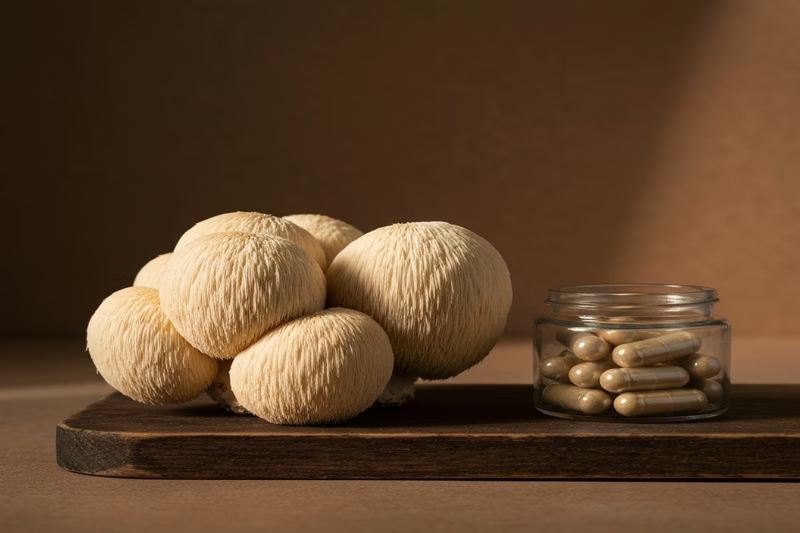
Lion's mane mushroom (250 mg)
Lion's mane gets a lot of attention online, but the human research is early. A 2023 pilot trial in Nutrients gave 41 healthy adults aged 18 to 45 either 1.8 grams of lion's mane or a placebo. One hour after a single dose, the lion's mane group was faster on a focus test called the Stroop task. After 28 days there was only a trend toward lower stress, and it did not reach statistical significance. The researchers said their results should be read with caution because the study was small.
NeuroSurge's 250 mg is well below the 1.8 grams used in that trial. Our lion's mane evidence and dose guide covers the rest of the research.
Ginkgo biloba (120 mg)
Ginkgo is one of the most studied herbs for the brain, and in healthy people the results are disappointing. A 2012 meta-analysis in Human Psychopharmacology pooled randomized trials measuring memory in 1,132 people, executive function in 534, and attention in 910. The effects were close to zero in all three areas. The results did not change with age, dose, or how long the trials ran.
Plenty of buyers look for ginkgo on a label, so it is easy to see why it is included. But if ginkgo is your main reason for considering NeuroSurge, that meta-analysis is worth reading first.
Alpha-GPC, huperzine A, acetyl-L-carnitine, and B vitamins
These four round out the formula. We did not find human trials in healthy adults at NeuroSurge's doses that were strong enough to cite here, so we are not counting them for or against the product. Think of them as extras, not as reasons to buy.
So, Does NeuroSurge Work? Our Honest Read
NeuroSurge is a reasonable, stimulant-free choice for adults who want to support focus and memory over a few months. Its two best-matched ingredients, Bacopa and phosphatidylserine, are included at doses that line up with published trials. DHA, Rhodiola, and lion's mane are present, but at lower amounts than researchers used. Ginkgo adds length to the label more than proof.
Put simply, NeuroSurge is not a pill that makes you sharper overnight. It is a daily formula whose best-studied ingredient was tested for 12 weeks or more. For someone in their 40s, 50s, or 60s who has noticed small lapses and is willing to be patient, it is worth trying. For someone who wants a quick lift before a big meeting, it is the wrong tool.
How to Give NeuroSurge a Fair Test
- Pick one thing to track before you start, such as how many items you remember from a grocery list or how often you lose your train of thought at work.
- Take it the way the label says: two capsules with breakfast, at about the same time each day.
- Keep your sleep, caffeine, and exercise habits steady, so you are testing the capsule and not your schedule.
- Write a one-line note at the end of each week.
- Mark day 50 on your calendar. The refund window is 60 days, which is shorter than the 12-week Bacopa trials, so decide by then whether to keep going.
If you see no change in the thing you tracked, that is useful information, and it is exactly what the guarantee is for.
NeuroSurge Side Effects and Who Should Ask a Doctor First
The phosphatidylserine, DHA, and Rhodiola trials above reported no serious side effects. That does not cover the full NeuroSurge formula, which has never been tested as a whole.
Our NeuroSurge review lists the label cautions. Talk to your doctor before starting if you take blood thinners, because the formula contains ginkgo, or if you take any prescription medicine for mood. It is not meant for anyone under 18. If you have a fish or shellfish allergy, ask the company about the source of the DHA.
One more point. If memory changes are sudden, getting worse quickly, or worrying the people close to you, skip the supplement aisle and book a doctor visit. Our guide to normal aging versus early memory loss explains which signs deserve a checkup.
NeuroSurge Price and Guarantee
As of our September 2026 review, NeuroSurge lists a regular price of $79 per bottle, with bundle pricing that brings it down to $49 per bottle. Orders are covered by a 60-day money-back guarantee. Offers on the official site change, so confirm the current price before you order. Check current NeuroSurge pricing on the official site.
How NeuroSurge Compares With Other Brain Supplements
If you are choosing between products, our side-by-side pages look at the same questions of dose and evidence: NeuroSurge vs Synaptigen, NeuroVera vs NeuroSurge, and our three-way NeuroSurge vs Memory Lift vs Prevagen breakdown. For the whole category, start with our guide to nootropics that actually work.
The bottom line: NeuroSurge is built around a few ingredients with real human research, and it is honest enough to skip stimulants. Give it at least two months, track one simple measure, and let the results, not the label, make the decision.
Read the Full NeuroSurge Review
Our full review covers the label, customer feedback, bundle pricing, and the type of buyer NeuroSurge suits best.
Read our NeuroSurge reviewLooking for Brain Health supplements?
Our experts have reviewed and compared the top brain health supplements to help you find the right one.
See our expert comparisonFrequently Asked Questions
Does NeuroSurge really work?
NeuroSurge itself has not been tested in a published clinical trial. Its best-studied ingredients do have human research: a 2014 meta-analysis of nine trials linked Bacopa monnieri to faster attention, and a 2010 trial found phosphatidylserine helped memory in adults who started with lower scores. Other ingredients, like ginkgo, showed no benefit in healthy people. It is a reasonable option for adults who want gradual, stimulant-free support and are willing to give it a couple of months.
How long does NeuroSurge take to work?
Plan on at least eight to twelve weeks. The Bacopa trials that showed benefits all lasted 12 weeks or longer, and the phosphatidylserine study ran for six months. Because the money-back guarantee is 60 days, decide around day 50 whether you want to continue.
What are the ingredients in NeuroSurge?
NeuroSurge contains Bacopa monnieri (300 mg), alpha-GPC (300 mg), N-acetyl L-carnitine (500 mg), lion's mane (250 mg), DHA (250 mg), Rhodiola rosea (200 mg), ginkgo biloba (120 mg), phosphatidylserine (100 mg), huperzine A (200 mcg), and a vitamin B complex.
Does NeuroSurge have side effects?
The trials on its main ingredients reported no serious side effects, but the full formula has not been studied. Talk to your doctor first if you take blood thinners or prescription mood medicine, and ask the company about the DHA source if you have a fish or shellfish allergy. It is not meant for anyone under 18.
Is NeuroSurge a stimulant?
No. NeuroSurge does not list caffeine or other stimulants. That makes it a poor choice if you want an immediate energy kick, and a better fit if you want steady daily support without jitters.
How much does NeuroSurge cost?
As of September 2026, NeuroSurge lists a regular price of $79 per bottle, with bundles that bring the cost to $49 per bottle. Every order includes a 60-day money-back guarantee. Check the official site for the current offer.
Is the ginkgo in NeuroSurge effective?
In healthy adults, probably not on its own. A 2012 meta-analysis covering more than 1,100 people found no measurable benefit from ginkgo for memory, attention, or executive function. NeuroSurge's case rests more on Bacopa and phosphatidylserine than on ginkgo.
Boost your brain health
Get research-backed cognitive health tips and honest supplement reviews.
No spam. Unsubscribe anytime.