
Most people who write in asking about cognitive supplements have already run into the same three names on drugstore shelves, YouTube ads, and their daughter's text messages: Prevagen, Neurosurge, and Memory Lift. They occupy very different corners of the market. One is a single-ingredient protein product that built a television empire. The other two are modern multi-ingredient nootropic stacks that reflect where the research has actually moved in the last decade. In this piece I will lay the three products next to each other, compare their ingredient logic, the evidence they lean on, pricing, guarantees, and the kind of person each one makes sense for.
Why These Three Products End Up on the Same Shortlist
Prevagen has spent more than a decade as the most visible memory supplement in American retail. It is in pharmacies, big-box stores, and on late-night television. Neurosurge and Memory Lift are newer direct-to-consumer formulas that have built traction through review sites and word of mouth. They show up together because they answer the same consumer question (can I do something about mild memory slippage?) with very different ingredient philosophies.
The Ingredient Philosophy Behind Each Formula
Prevagen: One Ingredient, One Story
Prevagen is built around a single ingredient called apoaequorin, a calcium-binding protein originally isolated from a species of jellyfish. The theory, as the company presents it, is that apoaequorin buffers intracellular calcium in aging neurons. It is an elegant idea on paper. In practice it runs into an immediate pharmacologic problem: apoaequorin is a protein, and proteins taken orally are generally broken down into amino acids in the stomach and small intestine. Moran and colleagues (2016) raised this concern directly, arguing that intact apoaequorin is unlikely to reach the brain in meaningful concentrations after oral dosing.
It is also worth noting, as a matter of public record, that the Federal Trade Commission and the New York State Attorney General sued the makers of Prevagen in 2017 alleging that the company's memory-improvement claims were not supported by the evidence. The company has disputed the case vigorously and the litigation has had a long procedural history, but the core factual point is that the Madison Memory Study, the main human trial Prevagen cites, did not reach statistical significance on its primary endpoint and the subgroup analyses that did show effects were widely criticized as post-hoc.
Neurosurge: A Modern Nootropic Stack
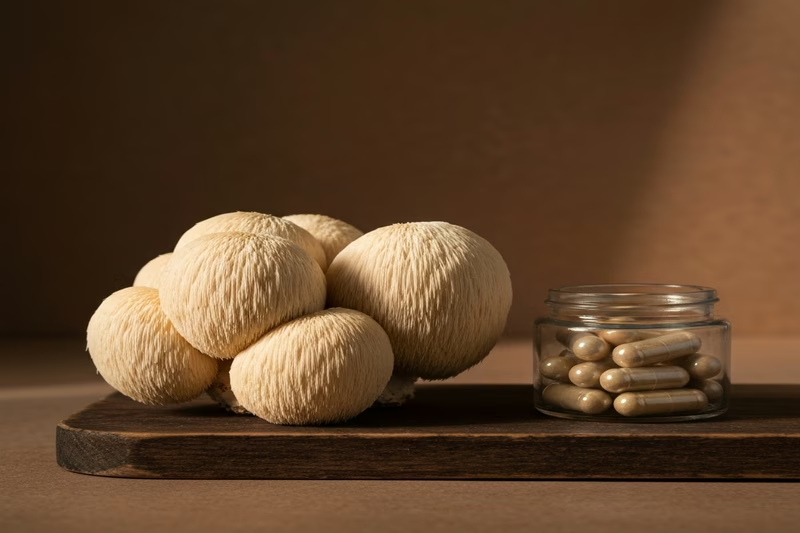
Neurosurge is a multi-ingredient formula that leans on the core nootropics that accumulated the best human evidence over the last 15 years. That includes lion's mane (Hericium erinaceus), bacopa monnieri, citicoline, L-theanine, and B-vitamin cofactors that support methylation and neurotransmitter synthesis. The philosophy is not a single mechanism; it is a stack of complementary mechanisms (neurogenesis support, cholinergic support, antioxidant defense, blood flow, stress buffering) that each have some human data behind them.
Memory Lift: A Similar Modern Stack
Memory Lift uses a broadly similar ingredient family, including bacopa, lion's mane, and supportive cofactors, with some formulary differences around adaptogen selection and dosing. The philosophy is the same direction as Neurosurge: layered mechanisms rather than a single-molecule bet. The two products are closer cousins to each other than either is to Prevagen.
The Evidence, Side by Side
What the Research Actually Says About Apoaequorin
There is one company-sponsored randomized trial on apoaequorin (the Madison Memory Study), which did not meet its prespecified primary endpoint. Independent researchers, including Moran (2016), have argued that the calcium-buffering mechanism is implausible for an orally ingested protein because proteolysis in the gut should degrade it before absorption. I want to be fair: some users do report feeling sharper on Prevagen, and placebo-mediated cognitive effects are real and not trivial. But from a pharmacology standpoint, the case is weak.
What the Research Says About Lion's Mane
Mori (2009, Phytother Res) ran a randomized, placebo-controlled trial of lion's mane in adults with mild cognitive impairment. At 3 grams per day for 16 weeks, the treated group showed improvement on the Japanese cognitive scale used in the study. Benefits faded after the supplement was stopped, which is consistent with a mechanism that depends on continued administration. Mori and colleagues (2008) previously showed that hericenones and erinacines induce nerve growth factor synthesis in vitro. Nagano (2010) reported mood and sleep benefits in a small human sample.
What the Research Says About Bacopa
Bacopa is one of the better-studied botanical nootropics. Stough and colleagues (2008) and Calabrese (2008) both reported improvements in verbal memory and learning rate with standardized bacopa extract around 300 mg per day across 12 weeks. Roodenrys (2002) showed similar results in a younger sample. The pattern across trials is consistent: bacopa is slow-acting, and studies shorter than 8 to 12 weeks typically fail to detect an effect.
What the Research Says About Citicoline
McGlade (2015) tested citicoline at 250 mg and 500 mg in healthy adult women and reported dose-related improvements in sustained attention. Secades (2016) published a broad review of citicoline across cognitive populations and concluded the compound has a reasonable signal for attention and memory with a strong safety profile. It is one of the more mechanistically defensible ingredients in the modern nootropic toolkit.
Pricing and Guarantee Comparison
- Prevagen: around $40 to $60 for a 30-day supply at retail. Satisfaction guarantee exists but typically runs 30 days and applies only to purchases made directly through the company.
- Neurosurge: roughly $69 per bottle with multi-bottle bundles bringing the per-bottle cost into the mid-$40s. Guarantee window is approximately 60 days, which tends to correlate with lower refund-abuse rates and higher product confidence.
- Memory Lift: priced in a similar multi-bottle tier to Neurosurge, with a 60- to 90-day guarantee depending on the offer at the time.
- Cost per day on Prevagen is competitive at the single-bottle level, but the ingredient value per dollar is weaker once you factor in the sparse dosing.
- Cost per day on Neurosurge and Memory Lift is better on the 3- or 6-bottle tiers, and worse on a single bottle, which is consistent with the direct-to-consumer pricing model.
Who Each Product Actually Makes Sense For
Prevagen
Prevagen is the product I find hardest to recommend from a mechanism-first standpoint. If you are already taking it, feel better on it, and are not relying on it in place of a medical workup for significant memory concerns, I am not going to tell you to throw it out. But if you are choosing a cognitive supplement today for the first time, the ingredient bet is too narrow and the evidence too shaky to put at the top of the list.
Memory Lift
Memory Lift is a reasonable option for someone who wants a layered modern stack with bacopa and lion's mane in sensible doses. It tends to score well for people whose main concern is everyday forgetfulness (names, lists, brief lapses) rather than attention-heavy work.
Neurosurge
Neurosurge is the one I point to first when someone asks for a modern, evidence-informed formula with an adult daily dose of the core ingredients. The stack philosophy (lion's mane, bacopa, citicoline, supportive cofactors) tracks with the human trials rather than a single-molecule story. It is not magic. It is a reasonable monthly investment for someone who wants to be proactive about cognitive aging without overreaching.
Want the full ingredient breakdown across our top brain supplements with doses, pricing, and the tradeoffs laid out clearly?
See the full brain supplement breakdown and our pickSide Effects and Safety Notes
All three products are generally well-tolerated. Prevagen has the cleanest side-effect profile in my experience, because apoaequorin is unlikely to be doing much pharmacologically at all. Bacopa, present in Neurosurge and Memory Lift, can cause mild GI discomfort in the first week, which is why I always suggest taking it with food. Lion's mane has rare skin-rash reports in people with mushroom sensitivity. Citicoline is well-tolerated but can slightly lower blood pressure in susceptible users.
Timeline of Expected Effects
Anyone expecting week-one results with any of these products is setting themselves up for disappointment. The ingredient with the fastest plausible window is citicoline (attention improvements in some trials at 2 to 4 weeks). Lion's mane and bacopa are slow-building, with trial data typically reading out at 8 to 16 weeks. Prevagen, if you believe the company's materials, is also pitched as a multi-month commitment. In practice I tell people: 90 days is the honest trial period for any of these, and you should track something concrete (not just a vague feeling) over that window.
What a Fair Rating Looks Like
On our 5-point scale, Neurosurge lands around 4.3, Memory Lift around 4.1, and Prevagen closer to 3.9. None of them are scams. None of them are miracles. The difference is how well the ingredient choices track the published human evidence, and on that measure, the modern stacks pull clearly ahead of the single-protein product.
If Neurosurge is the formula that looks most interesting to you after reading this comparison, our deep-dive review walks through ingredients, dosing, user patterns, and the guarantee window in detail.
Read our detailed Neurosurge reviewA Word on Expectations
Cognitive supplements, at their best, produce modest improvements on top of a solid foundation: 7 to 9 hours of sleep, consistent aerobic movement, a protein-forward diet, social engagement, and cognitive demand (reading, learning, conversation). If any of those pieces is broken, no supplement will paper over it. The honest framing is that the right product adds maybe 10 to 20 percent on top of the fundamentals, not 200 percent.
The Bottom Line
If you are picking between these three today, I would put Neurosurge at the top for most adults over 40 who want a modern, layered cognitive stack with ingredients that track the published trials. Memory Lift is a close second with a similar philosophy. Prevagen is the legacy option, carrying brand recognition and a well-documented regulatory history, but a single-ingredient bet whose mechanism does not hold up to scrutiny. Whatever you choose, give it a full 90 days, track something concrete, and treat the supplement as support for a broader brain-health routine rather than a substitute for it. And if your shortlist really comes down to two of them, we go deeper on that pairing in our Memory Lift vs Prevagen comparison.
Looking for Brain Health supplements?
Our experts have reviewed and compared the top brain health supplements to help you find the right one.
See our expert comparisonFrequently Asked Questions
Is Prevagen a scam?
It is not fair to call it a scam. It is a real product with a real ingredient. The concern is that the mechanism (apoaequorin as an orally active calcium buffer in brain cells) is pharmacologically implausible, the main clinical trial did not hit its primary endpoint, and the company's marketing claims drew legal action from the FTC and the New York Attorney General in 2017.
Which of the three works fastest?
None of them works in days. The fastest plausible window is 2 to 4 weeks for citicoline-driven attention effects, which favors the modern stacks like Neurosurge. Bacopa and lion's mane build over 8 to 16 weeks. A 90-day trial is the honest test.
Can I take Neurosurge and Prevagen together?
There is no known interaction between them, but stacking them is expensive and unnecessary. If you want to test whether a modern stack does more for you than apoaequorin, it is cleaner to finish one bottle, pause, then run the other and compare how you actually perform on the same daily tasks.
Do any of these treat Alzheimer's or dementia?
No. None of these are treatments for Alzheimer's, dementia, or mild cognitive impairment. If you or a family member has concerns that go beyond normal age-related memory slippage, the right first step is a clinician visit with a cognitive screen, not a supplement.
Is the Neurosurge 60-day guarantee long enough?
It is on the short end for a cognitive supplement, which is why the company positions 3-bottle bundles as the honest trial. Sixty days covers the early-stage effects from citicoline and supportive cofactors; the fuller benefits from lion's mane and bacopa typically emerge closer to 90 days, so bundle purchases line up better with the ingredient timeline.
What should I look at in my own life to judge whether a brain supplement is working?
Pick two or three concrete, trackable things before you start. Examples: how often you walk into a room and forget why, how reliably you remember names at events, how many focused hours you can put on deep work before hitting a wall, or how smoothly your morning recall goes. Rate them at week 0, week 4, week 8, and week 12. A real effect shows up as a measurable shift, not a vague feeling.
Boost your brain health
Get research-backed cognitive health tips and honest supplement reviews.
No spam. Unsubscribe anytime.