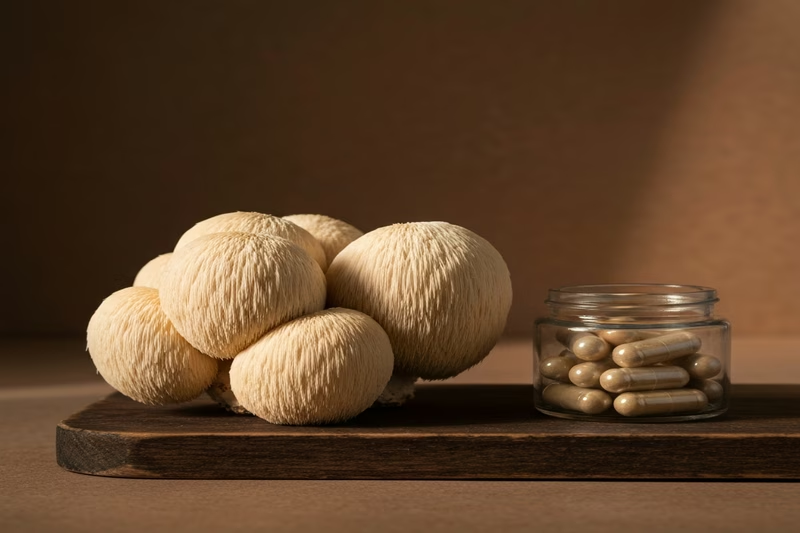

Lion's mane is probably the single most hyped cognitive mushroom on the market right now, and the gap between the hype and the actual evidence is wide in both directions. The internet will tell you it regrows brain cells. A skeptical read will tell you it does essentially nothing. Neither framing is accurate. There is a real and interesting body of preclinical and early human research on Hericium erinaceus, and there are real constraints on how much we can extrapolate. This piece will walk through what the research actually says, what dose the trials used, and what to look for on a label so you are not paying premium prices for filler.
The Mechanism: Why Researchers Got Interested
The scientific interest in lion's mane traces back to two families of compounds found in the mushroom: hericenones, concentrated in the fruiting body, and erinacines, concentrated in the mycelium. Mori and colleagues (2008) showed in vitro that these compounds can induce nerve growth factor (NGF) synthesis in cell culture. NGF is a signaling protein that supports the survival and maintenance of cholinergic neurons, the population most affected in Alzheimer's disease. That in vitro finding is what moved lion's mane from curiosity to cognitive-health candidate.
The catch is that in vitro NGF induction does not automatically translate to meaningful in vivo effects in humans. NGF is a large protein that does not cross the blood-brain barrier well, and the real question is whether oral lion's mane produces enough downstream signaling to matter. That is what the human trials were set up to answer.
The Human Evidence
Mori 2009: The Anchor Trial
The most cited human trial is Mori et al. (2009, Phytotherapy Research). It was a randomized, double-blind, placebo-controlled study of 30 older Japanese adults with mild cognitive impairment. The treatment group received 3 grams of Yamabushitake (lion's mane) per day in powder form for 16 weeks. Cognitive function was assessed using the Japanese revised Hasegawa Dementia Scale. The treatment group showed significant improvement at weeks 8, 12, and 16 compared with placebo. When the supplement was discontinued, scores declined over the following month. That withdrawal effect is actually informative because it suggests the benefit is dependent on continued use rather than a permanent rewiring.
Nagano 2010: Mood and Anxiety
Nagano and colleagues (2010) reported a small placebo-controlled study in menopausal women showing improvements on anxiety and depression scales after 4 weeks of lion's mane. The sample size was modest but the signal was consistent with the general picture of lion's mane as having both cognitive and mood effects, plausibly through overlapping mechanisms.
Saitsu 2019: Short-Term Cognitive Effects
Saitsu and colleagues (2019) looked at younger adults and reported improvements on a cognitive battery after 12 weeks of supplementation. This was one of the first reports suggesting lion's mane may support cognitive function in people without mild cognitive impairment, though the sample was small and the effect size modest. The pattern across trials is consistent: real but modest benefits that emerge over 8 to 16 weeks, not overnight.
Li 2020 and Erinacine Trials
More recent work on erinacine-enriched mycelium preparations has reported cognitive and biomarker signals in early Alzheimer's populations, though these trials are still small and the field is waiting for larger confirmatory studies. The direction of evidence is encouraging without being conclusive.
Fruiting Body vs Mycelium: The Debate
This is where label reading matters. The fruiting body is the above-ground mushroom and is the traditional form used in East Asian food and medicine. Hericenones are concentrated there. Mycelium is the fungal network grown in the substrate (often grain) and contains erinacines. Mycelium is cheaper and easier to produce, but if it is grown on grain, the final powder can contain a significant percentage of residual grain starch rather than actual fungal material.
The purist position is fruiting-body-only. The pragmatic position is that both hericenones and erinacines have plausible activity and a well-grown mycelium product (ideally grown on wood, with tested alpha-glucan and beta-glucan content) can be legitimate. What you want to avoid is a grain-grown mycelium with high residual starch and no verification of bioactive content.
What to Look For on a Lion's Mane Label
- Clear disclosure of whether the product uses fruiting body, mycelium, or a blend, and what proportion each represents.
- Beta-glucan content listed as a percentage, ideally 20 percent or higher for a fruiting-body extract.
- Alpha-glucan content disclosed, with low alpha-glucan favored because high alpha-glucan in a mycelium product usually reflects residual grain starch.
- Dual extraction (water and alcohol) when the product is an extract, because hericenones and erinacines have different solubility profiles.
- Third-party testing for heavy metals, which can accumulate in mushrooms grown on contaminated substrate.
- Dosing in the 500 to 3000 milligram per day range, with higher-end dosing closer to what the Mori 2009 trial used.
- Honest manufacturer disclosure about growing conditions (wood-grown vs grain-grown) for mycelium products.
Looking for a formula that pairs properly sourced lion's mane with other evidence-backed cognitive ingredients in adult doses?
See our top brain supplement picksDose and Timing
How Much
The Mori 2009 trial used 3 grams per day of the whole mushroom powder. Extract products, which concentrate the active compounds, typically dose lower, in the 500 to 1000 milligram range per day. Finding the line between the two requires looking at the extract ratio. A 10:1 extract at 500 mg is approximately equivalent to 5 g of raw mushroom in terms of starting material, though bioactive content varies by batch.
When to Take It
Morning is the most common timing because some users report a slight stimulating or focusing effect. It is not a stimulant in the caffeine sense, but taking it close to bedtime does not add anything and a subset of users find it keeps them more mentally active than they want at night. With food is generally recommended for GI tolerance, though lion's mane is relatively well-tolerated on an empty stomach.
Cycling
There is no strong evidence that cycling is needed. The Mori 2009 trial used continuous dosing for 16 weeks and the benefit was dependent on continued use. For cost reasons, some users run 12 weeks on and 4 weeks off to verify whether the product is still doing something noticeable.
Who Responds Best
In clinical experience, the people who notice the most from lion's mane are those with a specific baseline pattern: mild memory slippage with some brain fog, often accompanied by low-grade anxiety or mood flatness. The cognitive and mood effects seem to travel together. People who come in with pure attention problems (ADHD-type distractibility without memory concerns) often notice less from lion's mane and more from citicoline or combined choline products.
Side Effects and Safety
Lion's mane is one of the best-tolerated cognitive supplements on the market. The most commonly reported side effect is mild skin rash, typically in people with underlying mushroom sensitivity. Very rare case reports exist of more significant allergic reactions, so anyone with a known mushroom allergy should avoid it. Mild GI upset is possible with higher doses. There is no known interaction profile of major concern, but anyone on blood thinners should review with a clinician because theoretical platelet effects have been raised (without strong clinical data behind them).
Realistic Expectations Over 16 Weeks
Week 1 to 4, most users notice little to nothing. Week 4 to 8, some report subtle mood lift, better morning clarity, or slightly smoother recall. Week 8 to 16, the cognitive effects in the trial data emerge more clearly. Expecting a noticeable week-one effect is the most common way users end up dismissing the product. The honest trial period is 90 to 120 days.
Stacking Lion's Mane
The most evidence-backed stack adds bacopa monnieri (for memory consolidation, Stough 2008) and citicoline (for attention and phospholipid precursor supply, McGlade 2015) to lion's mane. Omega-3 DHA at a gram or more per day provides structural support for neuronal membranes. B-complex covers methylation cofactors (B6, B12, folate) that sit upstream of neurotransmitter synthesis. That combination is essentially what a well-formulated modern brain stack looks like.
If you want to see how lion's mane sits inside a complete stack at clinically relevant doses.
Read our Neurosurge reviewWhere Lion's Mane Falls Short
It is fair to note the limits. Human trials are small. Replication in larger samples is still ongoing. The NGF pathway, while interesting, is not fully characterized in humans taking oral supplements. And lion's mane is not a treatment for Alzheimer's, dementia, or any diagnosed cognitive condition. It is a supportive ingredient with a plausible mechanism and a modest but real signal in the literature. That is what it is, and that is enough for a reasonable adult decision about whether to include it in a brain-health routine.
The Bottom Line
Lion's mane has the best human evidence of any cognitive mushroom and one of the more plausible mechanisms of any botanical nootropic. The ceiling on effect size is modest (this is not a stimulant and not a miracle), but the floor is reassuring in terms of safety. Look for a product with disclosed fruiting body content or clean mycelium sourcing, beta-glucan testing, and a dose that reaches at least 500 mg of a standardized extract or 3 g of whole mushroom. Give it 90 to 120 days. Track something concrete. If it is working, you will notice it in the stability of your morning clarity, the smoothness of word recall, and a general sense of cognitive evenness rather than a dramatic shift.
Looking for Brain Health supplements?
Our experts have reviewed and compared the top brain health supplements to help you find the right one.
See our expert comparisonFrequently Asked Questions
How long until I feel lion's mane working?
Trial data suggests 8 to 16 weeks for measurable cognitive effects. Some users report subtle mood or clarity changes by week 3 or 4. If you are expecting a week-one effect, you will probably be disappointed and quit before the ingredient has had time to work.
Is fruiting body always better than mycelium?
Not always, but often. Fruiting body concentrates hericenones and avoids the grain-residue problem that affects many mycelium products. A well-produced wood-grown mycelium with disclosed beta-glucan content can be legitimate. What you want to avoid is grain-grown mycelium with no testing, which is mostly starch.
Can I take lion's mane every day long-term?
Long-term safety data past about a year of continuous use is limited, but within that window lion's mane has a clean tolerability profile. Most users and clinicians are comfortable with continuous daily use, with a periodic 2- to 4-week break being a reasonable option to verify ongoing benefit and manage cost.
Does lion's mane help with ADHD?
There is no strong evidence for lion's mane as an ADHD treatment. It is not a stimulant and does not work on the dopamine and norepinephrine pathways targeted by ADHD medications. For attention-focused support, citicoline has more direct evidence. Lion's mane may still contribute to overall cognitive stability in an ADHD user but should not be positioned as a treatment.
Can I cook with fresh lion's mane instead of a supplement?
Fresh lion's mane is a lovely culinary mushroom and does contain bioactives, but you would need to eat it in substantial quantities multiple times a week to approach trial-level doses. Most people who want a cognitive effect end up supplementing because the dose is more practical and consistent.
Is lion's mane safe with blood thinners?
There are theoretical concerns about platelet function based on limited in vitro data, without strong clinical evidence of a real interaction. Anyone on warfarin, newer anticoagulants, or antiplatelet drugs should discuss with a clinician before starting, as a standard caution rather than a known risk.
Boost your brain health
Get research-backed cognitive health tips and honest supplement reviews.
No spam. Unsubscribe anytime.