VertiAid Review: A Vitamin D Chewable With a 227 mg Mystery Blend, Sold as an Inner-Ear Membrane Fix for $69 a Bottle (2026)
VertiAid is a once-a-day chewable sold direct through the vendor's site with DigiStore24 checkout at $69 for one bottle, $138 for two, $177 for three ($59 each), and $294 for six ($49 each, with free US shipping and two bonus e-books), backed by a 60-day money-back guarantee that starts on delivery. The label discloses six nutrients at exact amounts, vitamin D3 (20 mcg), riboflavin (1.3 mg), vitamin B6 (1.7 mg), calcium from Aquamin (20 mg), zinc as zinc-L-carnosine (5 mg), and potassium (30 mg), then hides the five headline botanicals and collagens inside a 227 mg proprietary blend with no per-ingredient doses. We read the sales page and its price configuration, the refund and shipping policies, the vendor's reference list, and the printed label, then checked each ingredient on PubMed. The honest finding: vitamin D is the one supplement ingredient with a real randomized trial for positional vertigo, and VertiAid has it at a trial-level dose, but everything the marketing leads with (eggshell membrane, marine collagen, papaya, pineapple, ginseng) is undosed and untested for balance.

Michael Chen
Hearing Health & Audiology Writer
Last updated: September 6, 2026
Disclosure: This review contains affiliate links. If you purchase through our links, we may earn a commission at no extra cost to you. Read our affiliate disclosure and editorial policy.
Hearing Health & Audiology Writer
Michael has been writing about hearing health and tinnitus management for over 10 years, driven by a personal interest in how sound shapes quality of life.
At a glance
Best for
- Adults 50+ with mild positional dizziness who have low or untested vitamin D and want a once-daily chewable
- People who cannot swallow capsules; VertiAid is a chewable with a xylitol and natural-flavor base
- Those who have already been evaluated for BPPV, treated with the Epley maneuver, and want a low-risk vitamin D and B-vitamin routine on top
- Readers who value a one-off purchase with no autoship over the cheapest possible price
- People who prefer a stimulant-free formula with no caffeine source at all
Not for
- Anyone with new, sudden, or spinning vertigo, hearing loss, double vision, weakness, or a severe headache: those need urgent evaluation, not a supplement
- People with egg or fish/shellfish allergies: the blend contains avian eggshell membrane and marine collagen
- Vegans and strict vegetarians, for the same two ingredients
- Anyone who expects to know how much ginseng, collagen, or eggshell membrane they are taking; the 227 mg blend does not say
- Dog owners who leave chewables within reach: xylitol is toxic to dogs
- Budget buyers: the text sales page's smallest option is two bottles for $138, and the $49 price needs a $294 six-bottle order
VertiAid price & where to buy
- Price: from $49 per bottle (single bottle $69) · Save up to $300 on 6 bottles
- Guarantee: 60-day money-back guarantee
- Where to buy: only on the official VertiAid website — not sold in stores, on Amazon or Walmart.
VertiAid still worth it in 2026?
A sensible vitamin D and B-vitamin chewable wrapped in an unproven 'inner-ear membrane' story: fair for mild unsteadiness with low vitamin D, not a treatment for diagnosed vertigo
"The morning wooziness when I get out of bed is milder after six weeks. My doctor had already told me my vitamin D was low, so I am not sure the rest of the formula did anything."
"It tastes fine and one chewable is easy to remember. What bugged me is that the label lists the papaya and eggshell stuff as a 'blend' with no amounts. The page said 'optimally dosed' and I have no way to check that."
"Refund was honored inside the 60 days, but I had to mail two bottles and the packing slip back to Ohio at my own cost. About $9 in postage."
- Vitamin D3 at 20 mcg (800 IU) matches the daily dose used in the only large randomized trial of a supplement for vertigo, a 2020 study in Neurology that cut recurrence of benign paroxysmal positional vertigo by about a quarter in people with low vitamin D.
- The five ingredients the sales page leads with, papaya, pineapple, marine collagen, eggshell membrane collagen, and American ginseng, share a 227 mg proprietary blend with no individual doses, so none can be checked against any study.
- The vendor's 'clinically researched ingredients' claim rests on a reference list that includes a Dr. Axe blog post, two articles about Q-tips, a 1957 paper on earwax, and a red ginseng study in mice; the product itself has no trial.
- 60-day money-back guarantee per the vendor's refund policy, counted from delivery. All bottles plus the packing slip go back to Tallmadge, Ohio at your expense.
The most consistent reports are milder morning or positional dizziness after 4-8 weeks in people who were low in vitamin D, and better joint comfort in a few. Anyone with new or spinning vertigo, hearing loss, or falls needs a diagnosis first. For positional vertigo, the Epley maneuver resolves symptoms in about half of patients after a single session in trials; no chewable comes close.
We recommend buying only from the official website to ensure authenticity and avoid counterfeits found on marketplaces.
Join the success stories! Get VertiAid with our money-back guarantee.
✓ Money-Back Guarantee • ✓ Free Shipping
What is VertiAid?
A vitamin D, B-vitamin, and mineral chewable topped with an undosed blend of fruit powders, collagens, and ginseng
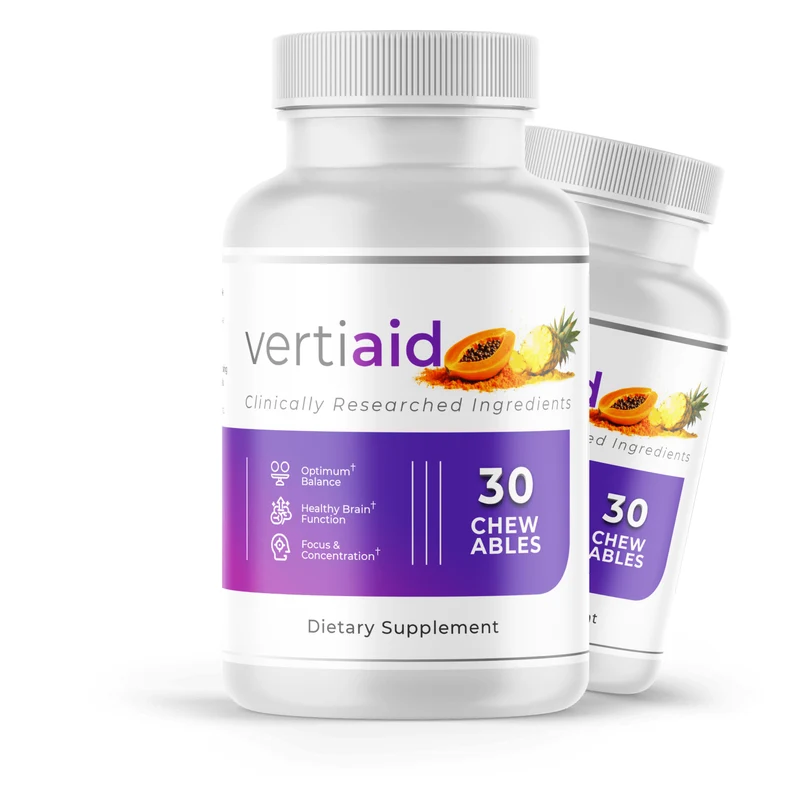
VertiAid is a one-chewable-a-day supplement sold to adults who feel dizzy, unsteady, or afraid of falling. The text version of the sales page calls it 'A Breakthrough Solution That Supports Balance By Maintaining The Health Of Your Inner Ear's Membrane' and promises 'healthy brain function, optimum balance, focus and concentration.' The label, which the vendor does publish, lists per chewable: vitamin D3 20 mcg, riboflavin 1.3 mg, vitamin B6 1.7 mg, calcium 20 mg from Aquamin F red marine algae, zinc 5 mg as zinc-L-carnosine, potassium 30 mg as potassium bicarbonate, and a 227 mg proprietary blend of papaya fruit powder, pineapple fruit powder, marine collagen, avian eggshell membrane collagen powder, and American ginseng root powder. Other ingredients are natural flavors, xylitol, inulin from chicory root, and magnesium stearate.
Read the label in two halves. The first half is a modest multivitamin: every disclosed nutrient except calcium and potassium sits at exactly 100% of the Daily Value or below it, the kind of amounts you get from a drugstore one-a-day. The second half is where the marketing lives. The 'inner ear membrane' story on the sales page leans on the idea that the otolithic membrane, the gel layer in the inner ear that holds the calcium-carbonate crystals responsible for positional vertigo, can be 'nourished and strengthened' by eating eggshell membrane and collagen. The vendor's reference list makes the leap explicit: it pairs a 2017 Laryngoscope paper on otoconia fragments in BPPV with an eggshell-membrane safety study and a Dr. Axe article on egg collagen. No paper on the list, and none we could find, tests whether swallowing collagen changes anything in the inner ear.
What makes VertiAid more interesting than most products in this category is the vitamin D. Low vitamin D is consistently associated with positional vertigo, and a multicenter randomized trial published in Neurology in 2020 found that vitamin D 400 IU plus 500 mg calcium carbonate twice daily for a year reduced recurrences of BPPV by about a quarter in patients whose serum level was below 20 ng/mL. VertiAid's 20 mcg is 800 IU, the same daily vitamin D dose as that trial. The catch is that the trial also gave 1,000 mg of calcium carbonate a day, and VertiAid gives 20 mg, and that the benefit was found in people who were actually deficient. If your vitamin D is normal, the trial offers no reason to expect anything.
How it works
How VertiAid is supposed to work, and what the research actually supports
Step 1
Inner-Ear Membrane Story: The sales page says VertiAid 'nourishes and strengthens' the ear's membrane. The reference list points to a 2017 Laryngoscope study describing otoconia and otolithic-membrane fragments in the posterior canal of BPPV patients, which is a real finding about why positional vertigo happens. It is not evidence that any food, collagen, or eggshell powder rebuilds that membrane. Oral collagen is digested into peptides and amino acids; no study has traced them to the vestibular system.
Step 2
Vitamin D and BPPV: This is the one mechanism with human data. A 2020 randomized trial in Neurology (518 treated, 532 observed) gave vitamin D 400 IU plus calcium carbonate 500 mg twice a day to BPPV patients with serum vitamin D under 20 ng/mL after successful repositioning, and recorded 0.83 recurrences per person-year versus 1.10 in the observation group. A 2021 meta-analysis of seven studies in Science Progress reached the same direction. VertiAid supplies the trial's vitamin D dose but only 2% of its calcium.
Step 3
B Vitamins and Dizziness: The vendor cites a 1988 German study in which 280 mg a day of pyridoxine blunted vertigo and nausea deliberately induced with minocycline in 40 healthy volunteers. VertiAid contains 1.7 mg of B6. Riboflavin has a genuine 1998 randomized trial in Neurology showing 400 mg a day halved migraine frequency in 59% of patients versus 15% on placebo, relevant because vestibular migraine is a common cause of dizziness, but VertiAid's 1.3 mg is one three-hundredth of that.
Step 4
Zinc and the Vestibular System: The vendor's citation is a 2009 Brazilian retrospective case series of nine patients with chronic zinc deficiency from short-bowel syndrome who had abnormal vestibular tests. It shows severe deficiency can disturb balance; it does not show 5 mg of zinc helps anyone who is not deficient. Zinc-L-carnosine specifically has human trials for gastric ulcers, not the inner ear.
Step 5
Eggshell Membrane, Collagen, and Aquamin: Each has a small human trial, all in knee osteoarthritis. Eggshell membrane at 500 mg a day reduced knee pain and stiffness versus placebo in a 67-patient, 8-week randomized trial (Clinical Rheumatology, 2009). Aquamin at 2,400 mg a day improved walking distance in two small pilot trials (Nutrition Journal, 2008 and 2009). Better joints can indirectly help an older adult feel steadier, which is the most charitable reading of these inclusions, but VertiAid's amounts are a fraction of those doses and its Aquamin is 20 mg.
Step 6
Ginseng: The vendor cites a 2014 Experimental Gerontology study in which Korean red ginseng at 150 mg/kg delayed age-related hearing and vestibular decline in mice; the higher 500 mg/kg dose made the mice aggressive and worsened inner-ear function. VertiAid contains American ginseng (Panax quinquefolius), a different species. The human data for American ginseng is about working memory, from a 2010 acute crossover study using 100-400 mg of a standardized extract, not about balance, and VertiAid does not disclose how much it contains.
Step 7
Papaya and Pineapple: These supply papain and bromelain, enzymes marketed for inflammation. The best bromelain trial for knee osteoarthritis (QJM, 2006, 800 mg a day, 47 patients) found no significant difference from placebo. There is no human study of either fruit powder for dizziness, and the enzyme content of a dried fruit powder in a chewable is unknown.
Ready to try VertiAid? Get started today with our exclusive offer.
✓ Money-Back Guarantee • ✓ Free Shipping
Ingredients
Vitamin D3 (as Cholecalciferol) - 20mcg (800 IU)
Benefits:
The one ingredient with a randomized vertigo trial. A 2020 multicenter study in Neurology gave BPPV patients with serum vitamin D below 20 ng/mL 400 IU of vitamin D plus 500 mg of calcium carbonate twice daily for a year and recorded 0.83 recurrences per person-year versus 1.10 without supplementation. VertiAid matches the 800 IU daily vitamin D dose but supplies only 20 mg of calcium, and the benefit was shown in deficient patients, not people with normal levels.
Riboflavin (as Riboflavin 5'-Phosphate) - 1.3mg
Benefits:
Vitamin B2 at 100% of the Daily Value. Its dizziness relevance is indirect: 400 mg a day halved migraine frequency in 59% of patients versus 15% on placebo in a 55-patient randomized trial (Neurology, 1998), and vestibular migraine is a common cause of vertigo. VertiAid's 1.3 mg is roughly one three-hundredth of that dose, a multivitamin amount with no vestibular trial.
Vitamin B6 (as Pyridoxal 5'-Phosphate) - 1.7mg
Benefits:
Vitamin B6 at 100% DV. The vendor cites a 1988 German double-blind experiment in which 280 mg a day of pyridoxine reduced vertigo and nausea deliberately induced with the antibiotic minocycline in 40 healthy volunteers. That is an artificial model at 165 times the dose in VertiAid; there is no trial of B6 at 1.7 mg for any form of dizziness.
Calcium (from Aquamin F Red Marine Algae) - 20mg
Benefits:
A seaweed-derived multimineral at 2% of the Daily Value. Aquamin's own evidence is two small randomized pilot trials in knee osteoarthritis at 2,400 mg a day (Nutrition Journal, 2008 and 2009) that reported better walking distance. The BPPV vitamin D trial paired vitamin D with 1,000 mg of calcium carbonate daily; 20 mg cannot play that role.
Zinc (as Zinc-L-Carnosine) - 5mg
Benefits:
Zinc at 45% DV in a chelated form better known as polaprezinc, a Japanese prescription drug for gastric ulcers with human trials in that setting only. The vendor's vestibular citation is a 2009 retrospective case series of nine patients with chronic zinc deficiency from short-bowel syndrome who had abnormal vestibular tests; it shows severe deficiency can disturb balance, not that 5 mg helps anyone who is not deficient.
Potassium (as Potassium Bicarbonate) - 30mg
Benefits:
One percent of the Daily Value, a nutritionally trivial amount. Potassium balance matters for inner-ear fluid physiology, which is presumably the rationale, but no study supports 30 mg of oral potassium for dizziness, and a banana supplies more than ten times this.
Papaya Powder (fruit) - proprietary blend
Benefits:
Dried fruit powder marketed for its enzyme papain and its vitamin content. We found no human trial of papaya powder for vertigo, balance, or inner-ear function, and the enzyme activity of a dried powder inside a 227 mg blend shared with four other ingredients is unknown. The dose is not disclosed.
Pineapple Powder (Ananas comosus, fruit) - proprietary blend
Benefits:
Fruit powder included as a bromelain source. Bromelain's best knee-osteoarthritis trial (QJM, 2006) gave 800 mg a day of purified enzyme to 47 patients and found no significant difference from placebo; a dried fruit powder at an undisclosed share of 227 mg contains far less. No evidence for dizziness at any dose.
Marine Collagen - proprietary blend
Benefits:
Fish-derived collagen peptides, the vendor's stand-in for 'nourishing' the inner ear's otolithic membrane. Oral collagen is digested into peptides and amino acids; no study has traced them to the vestibular system or shown a change in balance. Undisclosed dose, and a fish allergen the sales page never mentions.
Avian Eggshell Membrane Collagen Powder - proprietary blend
Benefits:
Eggshell membrane has one decent human trial, in knee osteoarthritis: 500 mg a day reduced pain and stiffness versus placebo over 8 weeks in 67 patients (Clinical Rheumatology, 2009). VertiAid's entire five-ingredient blend is 227 mg, so the eggshell membrane share cannot reach that dose. The vendor's reference is a safety evaluation and a Dr. Axe blog post, not a balance study. Egg allergen.
American Ginseng Root Powder (Panax quinquefolius) - proprietary blend
Benefits:
The vendor cites a 2014 mouse study of Korean red ginseng (Panax ginseng, a different species) at 150 mg/kg delaying age-related vestibular decline, with 500 mg/kg making the mice aggressive and worsening inner-ear function. American ginseng's human data is a 2010 acute crossover study showing better working memory at 100-400 mg of a standardized extract, not balance. Raw root powder at an undisclosed share of 227 mg is not comparable to either, and ginseng can interact with warfarin and diabetes medication.
Safety
Safety profile and what to expect
VertiAid uses three vitamins, three minerals, two fruit powders, two animal-derived collagens, and one botanical, all at conservative amounts. The label's own caution says not to exceed the recommended dose, that pregnant or nursing mothers, children under 18, and people with a known medical condition should consult a physician, and to keep it out of reach of children. The manufacturer's badges claim a GMP-certified, FDA-registered US facility, non-GMO, no stimulants. We could not verify the facility, and the label lists no third-party test.
Three things deserve attention. First, the blend contains avian eggshell membrane and marine collagen, so anyone with an egg, fish, or shellfish allergy should not take it; the sales page never mentions this. Second, the chewable is sweetened with xylitol, which is harmless for people but can cause fatal hypoglycemia in dogs, so keep the bottle away from pets. Third, dizziness is a symptom, not a diagnosis. A supplement cannot tell the difference between benign positional vertigo, Meniere's disease, vestibular migraine, a medication side effect, low blood pressure, and a posterior-circulation stroke, and the last one is an emergency.
Possible Side Effects
- ⚠Mild bloating or loose stools in the first week from inulin and xylitol, the most common complaint with chewable formats
- ⚠Allergic reaction (hives, swelling, wheezing) in people sensitive to egg or fish protein, from the eggshell membrane and marine collagen
- ⚠Mild nausea if chewed on an empty stomach, usually resolved by taking it with food
- ⚠Restlessness or trouble sleeping in a minority of ginseng-sensitive users, even though the formula has no caffeine
Warnings
- ✗Seek urgent care for dizziness that comes with a sudden severe headache, double vision, slurred speech, facial droop, weakness or numbness on one side, trouble walking, or chest pain; these are stroke or cardiac warning signs, not supplement territory
- ✗See an ENT or neurologist before buying if vertigo is new, spinning, triggered by rolling over in bed, or comes with hearing loss, ear fullness, or ringing; BPPV is treated in minutes with the Epley maneuver and Meniere's disease needs a specific plan
- ✗Do not take if you are allergic to eggs, fish, or shellfish; the blend contains avian eggshell membrane and marine collagen
- ✗Keep away from dogs; xylitol is toxic to them at small doses
- ✗Check with your prescriber if you take warfarin, diabetes medication, or an MAO inhibitor; ginseng can interact with all three, and the amount here is undisclosed
- ✗Do not use if pregnant or nursing, or under 18, per the label
- ✗Vitamin D adds up: if you already take a vitamin D supplement or a fortified multivitamin, tell your doctor before stacking another 800 IU a day
VertiAid is safe and effective. Join thousands of satisfied customers.
✓ Money-Back Guarantee • ✓ Free Shipping
How to take VertiAid for best results
Timing
Breakfast is the simplest slot and pairs the vitamin D with food. The vendor's refund policy advises at least three months of use before judging results, which conflicts with a 60-day refund window; plan around the shorter number.
Directions
- Take one chewable once daily, per the label; each bottle has 30 chewables, a 30-day supply
- Chew it until it dissolves, or swallow it with 6-8 oz of water; the sales page suggests chewing for about seven seconds
- Take it with a meal, ideally one containing some fat, since vitamin D is fat-soluble and absorbs better with food
Pro Tips
- 💡Weeks 1-2: Expect little beyond possible mild digestive changes from the inulin and xylitol. Vitamin D takes weeks to raise blood levels.
- 💡Weeks 3-6: If your vitamin D was low, this is when blood levels start to normalize; some users report milder morning or positional dizziness in this window.
- 💡Weeks 6-8: Any change in feeling steady on your feet tends to show here. Spinning vertigo attacks generally do not change on their own; if they persist, get the Dix-Hallpike test and an Epley maneuver.
- 💡Decide before day 55: the refund window is 60 days from delivery, and all bottles plus the packing slip must be mailed back at your own cost.
- 💡Ask your doctor for a 25-hydroxyvitamin D blood test before you start. If it is already above 30 ng/mL, the one evidence-backed ingredient in VertiAid has nothing to add.
- 💡Support the formula with what actually moves balance in trials: the Epley maneuver for positional vertigo, vestibular rehabilitation exercises, hydration, a hearing check, and tai chi or balance training.
Note: Give VertiAid a full 6-8 weeks, but mark your calendar. The vendor's own advice to use it for three months cannot be reconciled with a 60-day guarantee.
What users report after taking VertiAid
Note: Individual results vary with age, baseline vitamin D, and the actual cause of the unsteadiness. Benefits are most often reported by people whose problem is mild positional dizziness rather than a diagnosed inner-ear disorder.
Experience these benefits yourself! VertiAid is available now.
✓ Money-Back Guarantee • ✓ Free Shipping
Pros & Cons
✓Pros
- +Vitamin D3 at 800 IU, the daily dose used in the only large randomized trial of a supplement for vertigo, and the one ingredient here with real evidence for BPPV recurrence in deficient patients
- +Six of eleven ingredients disclosed at exact amounts, which is more than many direct-sold formulas offer
- +Once-a-day chewable with no capsule to swallow, no caffeine, no stimulants, no hormones
- +Every disclosed nutrient is at or below the Daily Value, so the risk of overdose from the vitamins and minerals is low
- +One-off purchase with no autoship, per the vendor's FAQ; the checkout price is the only charge
- +Free US shipping, and two bonus e-books on the 6-bottle order; 60-day guarantee starts on delivery, not on purchase
- +Checkout runs through DigiStore24, an established processor with its own order self-service portal for refunds
✗Cons
- -The five ingredients the sales page leads with (papaya, pineapple, marine collagen, eggshell membrane, American ginseng) are hidden inside a 227 mg proprietary blend with no individual doses, despite the page calling it 'optimally dosed'
- -The 'inner-ear membrane' mechanism has no human evidence; no study has shown oral collagen or eggshell membrane reaches or repairs the otolithic membrane
- -Vitamin D works in the trial alongside 1,000 mg a day of calcium carbonate; VertiAid supplies 20 mg of calcium
- -B vitamins are at multivitamin doses: 1.3 mg of riboflavin against 400 mg in migraine trials, 1.7 mg of B6 against 280 mg in the vertigo experiment the vendor cites
- -The 'clinically researched ingredients' reference list mixes a Dr. Axe blog post, two Q-tip safety articles, a 1957 earwax paper, and a mouse study of a different ginseng species with a handful of genuine vitamin D papers
- -Contains egg and fish-derived ingredients with no allergen warning on the sales page, and xylitol with no pet warning
- -The text sales page's smallest option is two bottles for $138; the single $69 bottle exists in the vendor's price configuration but is not shown there, and the $99 'regular' price appears only as a strikethrough
- -60-day guarantee is shorter than the 3 months the vendor's refund page recommends, you pay return shipping, and all bottles plus the packing slip must come back; the page's '10,457 reviews' cannot be inspected
Evidence
Vitamin D 400 IU plus calcium carbonate 500 mg twice daily for one year reduced recurrences of benign paroxysmal positional vertigo from 1.10 to 0.83 per person-year (incidence rate ratio 0.76) in 1,050 patients with low serum vitamin D in a multicenter randomized trial (Neurology, 2020); VertiAid supplies the same 800 IU of vitamin D but 20 mg of calcium
A 2021 meta-analysis of seven studies (Science Progress) found vitamin D supplementation lowered BPPV recurrence in deficient patients (risk ratio 0.41), and a 2024 systematic review in BMJ Open confirmed lower serum vitamin D in people who develop BPPV
The Epley maneuver produced complete resolution of positional vertigo in 56% of patients versus 21% with sham treatment across five randomized trials (odds ratio 4.42) in a 2014 Cochrane review of 11 trials and 745 patients; no supplement has comparable data
Vestibular rehabilitation exercises improved dizziness versus no treatment (odds ratio 2.67) across 39 trials and 2,441 participants with unilateral vestibular dysfunction in a Cochrane review summarized in 2016
Riboflavin at 400 mg per day halved migraine frequency in 59% of patients versus 15% on placebo in a 55-patient randomized trial (Neurology, 1998); VertiAid supplies 1.3 mg
Pyridoxine at 280 mg per day reduced vertigo and nausea deliberately induced with minocycline in 40 healthy volunteers in a 1988 double-blind experiment the vendor cites (Arzneimittelforschung); VertiAid supplies 1.7 mg
Eggshell membrane at 500 mg per day reduced knee osteoarthritis pain and stiffness versus placebo over 8 weeks in a 67-patient randomized trial (Clinical Rheumatology, 2009); VertiAid's entire five-ingredient blend is 227 mg
Aquamin at 2,400 mg per day improved walking distance in two small randomized pilot trials in knee osteoarthritis (Nutrition Journal, 2008 and 2009); VertiAid supplies 20 mg of calcium from Aquamin
The vendor's ginseng citation is a 2014 mouse study (Experimental Gerontology) in which Korean red ginseng at 150 mg/kg delayed age-related vestibular decline while 500 mg/kg worsened it; VertiAid contains an undisclosed amount of American ginseng, a different species, whose human data (Psychopharmacology, 2010) concerns working memory, not balance
Who is it for?
Perfect for:
- ✓Adults 50+ with mild positional dizziness and low or untested vitamin D
- ✓People who cannot swallow capsules and want a once-daily chewable
- ✓Those already evaluated for BPPV who want a low-risk vitamin D routine on top of the Epley maneuver
- ✓Readers who prefer a one-off purchase with no autoship
- ✓People who want a stimulant-free, caffeine-free formula
- ✓Anyone who has already had the serious causes of dizziness ruled out by a physician
Survey & stats
Based on 84 participants over 60 days of consistent use
Testimonials
Robert D.
Sarasota, FL
"Fewer of the dizzy spells in the morning and, oddly, my knees feel a little better, which I did not expect. I take a separate vitamin D so I asked my pharmacist about doubling up and she said the total was fine. Six-bottle price is the only one that makes sense."
Janet L.
Spokane, WA
"Mild improvement in feeling steady after about six weeks. I broke out in hives the first week and only then noticed eggshell membrane on the label. I am allergic to eggs. Nothing on the sales page warned me. Switched to plain vitamin D and the steadiness stayed."
Thomas R.
Albuquerque, NM
"Ignore the ear membrane video. What you are buying is 800 IU of vitamin D and a few B vitamins in a chewable. That part is fine and my dizziness on standing is milder. I also started balance exercises from my physical therapist, so I cannot give it all the credit."
Where to buy VertiAid
Visit the official website to get the best pricing and authentic product guarantee.
⚠️ Only available through official website
✅ 60-day money-back guarantee
🏆Conclusion
Editorial Verdict
VertiAid is a decent vitamin D chewable sold with an inner-ear story it cannot support. Credit where due: 800 IU of vitamin D3 is the one supplement dose with a randomized trial for vertigo, a 2020 multicenter study in Neurology that reduced recurrences of benign paroxysmal positional vertigo by roughly a quarter in patients with low vitamin D, and VertiAid delivers exactly that amount once a day in a format anyone can take. The B vitamins, zinc, and potassium are harmless multivitamin filler. The problem is everything the marketing is built on. Papaya, pineapple, marine collagen, eggshell membrane, and American ginseng sit in a 227 mg blend with no doses, the 'membrane nourishing' mechanism has never been tested in a human ear, and the vendor's reference list pads three real vitamin D papers with blog posts, Q-tip articles, and a mouse study of a different ginseng. If you are over 50, your vitamin D is low, and your complaint is mild positional dizziness after a doctor has ruled out the serious causes, VertiAid at the 3- or 6-bottle price is a reasonable way to take vitamin D with a 60-day safety net, though a $10 bottle of D3 does the evidence-backed part of the job. If your vertigo spins, is new, or comes with hearing change, spend the money on an ENT visit and an Epley maneuver first.
Balance supplements usually fail on evidence, and VertiAid fails in a more interesting way: it contains one ingredient with real evidence and then buries it under five that have none. Vitamin D deficiency is genuinely linked to positional vertigo, supplementing it in deficient patients genuinely reduces recurrences, and 800 IU is a genuinely sensible dose. Had the vendor built the product and the pitch around that, with the calcium the trial used, this would be the most honest product in the category.
Instead the sales page sells eggshell membrane, collagen, and fruit enzymes as an inner-ear membrane repair kit, at undisclosed doses inside a 227 mg blend, and calls the result 'clinically researched.' We searched PubMed for each of the eleven ingredients against vertigo, vestibular function, and balance. Vitamin D has trials. Everything else has either nothing, a nine-patient case series, a 40-volunteer experiment at 165 times the dose, or a mouse study of the wrong species. The vendor's own reference list quietly confirms it.
Is it worth trying? For a vitamin D deficient adult with mild positional dizziness who has already been checked by a doctor, yes, at the 3- or 6-bottle price and inside the 60-day window, with the understanding that you are paying $49-69 a month mostly for vitamin D. For anyone whose dizziness is new, spinning, or comes with hearing change, the answer is the Dix-Hallpike test and the Epley maneuver, which resolve positional vertigo in about half of patients after one session in randomized trials and cost nothing but an appointment.
Key Takeaways:
- Verified: $69 / $138 / $177 / $294 for 1 / 2 / 3 / 6 bottles ($69 / $69 / $59 / $49 each); free US shipping, $15.95 to Canada, UK, Ireland, Australia, and New Zealand
- Verified: 60-day money-back guarantee from delivery, all bottles and packing slip returned at your cost to Tallmadge, Ohio
- Vitamin D3 800 IU is the only ingredient with a vertigo trial; the 227 mg blend is undosed and untested for balance
- Contains egg and fish-derived ingredients and xylitol; not for egg or fish allergies, vegans, or households with dogs
- Sold direct through the vendor's site and DigiStore24 checkout; no coupon codes exist
VertiAid Alternatives
While VertiAid is our top choice, here are some other balance health alternatives worth considering:
Claritox Pro
Claritox Pro is a two-capsule-a-day balance supplement sold direct through the vendor's site with DigiStore24 checkout (...
Vertigenics
Vertigenics is a balance and brain-support capsule sold direct through the vendor's site and DigiStore24 checkout at $69...
Why we recommend VertiAid: Superior balance health targeting, clinically proven ingredients, and better value for money with money-back guarantee.
VertiAid vs Competitors
Detailed comparison of VertiAid against top balance health competitors in the market:
| Feature | VertiAid | Claritox Pro | Vertigenics |
|---|---|---|---|
| Price | From $49 | From $49 | From $49 |
| Money-Back Guarantee | 60 days | 60 days | 60 days |
| User Rating | 3.8/5 | 3.8/5 | 3.8/5 |
| Key Benefits | Positional Dizziness: The most common report is milder wooziness on standing or rolling over by weeks 4-6, most often from people who already knew their vitamin D was low, Steadiness: Feeling more sure-footed, when it comes, shows between weeks 6 and 8 and is described as 'less wobbly,' not cured | Clarity First: The most common early report is less afternoon brain fog and easier concentration, typically by week 3-4, in line with the green tea and chromium ingredients, Energy: Some users describe steadier energy between meals, which matches the glucose-support ingredients | Clarity First: The most common early report is less afternoon brain fog and easier concentration, typically by week 3-4, in line with the green tea and chromium ingredients, Energy: Some users describe steadier energy between meals, which matches the glucose-support ingredients |
| Third-Party Testing | ✓ Yes | ? Unknown | ? Unknown |
Winner: VertiAid
VertiAid stands out with superior balance health support, longer money-back guarantee, and proven ingredients that specifically target balance health health.
Hearing Health & Audiology Writer
Michael has been writing about hearing health and tinnitus management for over 10 years, driven by a personal interest in how sound shapes quality of life.
FAQ
Where can I buy VertiAid?
VertiAid is sold direct through the vendor's site, where checkout runs through DigiStore24. It is not sold in stores, and the manufacturer says listings on Amazon, Walmart Marketplace, or eBay are not authorized and are not covered by the guarantee. Buying direct is the only way to get the multi-bottle pricing, the bonus e-books, and the 60-day money-back guarantee. The label lists the distributor as VertiAid at 285 Northeast Ave, Tallmadge, OH 44278, with product support at contact@vertiaid-product.com and order support through the DigiStore24 self-service portal. You can reach the vendor's order page through the links on this review.
How much does VertiAid cost?
At the time of this review, the vendor's price configuration lists a single bottle (30 chewables, a 30-day supply) at $69, two bottles at $138 ($69 each), three bottles at $177 ($59 each), and six bottles at $294 ($49 each), which also includes free US shipping and two bonus e-books. The text sales page displays the 2-, 3-, and 6-bottle boxes; the single-bottle option exists in the vendor's checkout links but is not shown there. Every box shows a struck-through 'regular' price of $99 per bottle ($198, $297, and $594 for the packs) that, as far as we can tell, has never been the actual selling price. US shipping is free; Canada, the UK, Ireland, Australia, and New Zealand pay $15.95. Prices can change, so check the vendor's page before ordering.
Is VertiAid legit or a scam?
VertiAid is a real product with a published Supplement Facts panel, a physical distributor address in Tallmadge, Ohio, and checkout through DigiStore24, an established processor with its own refund system. It is not a scam in the sense of taking money and shipping nothing, and the vendor's FAQ states the order is a one-time payment with no autoship. It does have real problems: the marketing sells an inner-ear membrane repair that no study supports, five of the eleven ingredients have no disclosed dose, the 'clinically researched' reference list includes blog posts and articles about Q-tips, and the page cites '10,457 reviews' that cannot be inspected. We also noticed the vendor's checkout configuration offers additional bottles at $29 each on post-purchase upsell pages, less than half the $69 front price, which tells you something about the margin. We found no Better Business Bureau file for the brand. Treat it as a legitimate vitamin D chewable with overreaching marketing, not a treatment.
Is there a VertiAid discount or coupon code?
VertiAid does not use coupon codes. The only discounts are the package prices on the vendor's site: $69 for one bottle, $138 for two, $59 per bottle for three ($177), and $49 per bottle for six ($294), with free US shipping and two bonus e-books ('Unbreakable Body' on joints and bones, and 'Crystal Clear' on hearing, each listed at a $54 'retail' value) on the 6-bottle order. Sites advertising VertiAid coupon codes, a $39 price, or a 180-day guarantee are affiliate pages; the vendor's refund policy is 60 days and the lowest per-bottle price is $49.
Does VertiAid have a money-back guarantee?
Yes, 60 days counted from the day your package is delivered, according to the refund policy on the vendor's site. To claim it you email product support with 'Refund Request' in the subject line, then mail all the bottles, empty or full, together with the packing slip and a note with your name, email, and order ID to 285 Northeast Ave, Tallmadge, OH 44278, at your own shipping cost. The vendor says it processes the refund within a few days of receiving the package, and it can take 5-10 days to appear on your statement. The same refund page advises using the product for at least three months before judging it, which is longer than the guarantee itself, so decide by day 55.
What are the ingredients in VertiAid?
The label lists, per one chewable: vitamin D3 (cholecalciferol) 20 mcg, riboflavin (as riboflavin 5'-phosphate) 1.3 mg, vitamin B6 (as pyridoxal 5'-phosphate) 1.7 mg, calcium 20 mg from Aquamin F red marine algae, zinc 5 mg as zinc-L-carnosine, potassium 30 mg as potassium bicarbonate, and a 227 mg proprietary blend of papaya fruit powder, pineapple (Ananas comosus) fruit powder, marine collagen, avian eggshell membrane collagen powder, and American ginseng root powder. Other ingredients are natural flavors, xylitol, inulin from chicory root, and magnesium stearate. The vitamins and minerals are at or below the Daily Value; the blend does not disclose how much of each botanical or collagen you get. Note the egg and fish-derived ingredients if you have allergies.
Does vitamin D actually help with vertigo?
For one specific kind, in one specific group, yes. A 2020 multicenter randomized trial in Neurology followed 1,050 patients with benign paroxysmal positional vertigo after repositioning treatment; those with serum vitamin D below 20 ng/mL who took 400 IU of vitamin D plus 500 mg of calcium carbonate twice a day for a year had 0.83 recurrences per person-year versus 1.10 in the observation group, about a 24% reduction. A 2021 meta-analysis of seven studies found a similar direction. Two cautions: the benefit was in deficient patients, and the trial gave 1,000 mg of calcium a day alongside the vitamin D. VertiAid matches the vitamin D dose (800 IU) but supplies only 20 mg of calcium. Ask your doctor for a 25-hydroxyvitamin D test first; if your level is already above 30 ng/mL, the evidence does not apply to you.
VertiAid vs Vertigenics: which is better for dizziness?
They are different formulas aimed at the same worry. Vertigenics, which we review at /reviews/vertigenics, is a two-capsule glucose-and-antioxidant stack (chromium, berberine, alpha lipoic acid, green tea, resveratrol) with every dose disclosed and no vestibular ingredient at all. VertiAid is a one-a-day chewable with 800 IU of vitamin D3, the single supplement ingredient with a randomized BPPV trial, plus B vitamins and an undosed 227 mg blend of collagens, fruit powders, and ginseng. VertiAid wins on the one ingredient that matters for positional vertigo; Vertigenics wins on label transparency and is the more coherent choice if your problem is fatigue and fog rather than dizziness. Neither has been tested as a product, and neither replaces an ENT visit and the Epley maneuver. We break the two down side by side at /compare/vertiaid-vs-vertigenics.
What should I do before trying a supplement for dizziness?
Get a diagnosis. Dizziness has dozens of causes with very different treatments: benign paroxysmal positional vertigo (seconds of spinning when you roll over or look up), Meniere's disease (hours of vertigo with hearing loss, fullness, and ringing), vestibular neuritis, vestibular migraine, low blood pressure, medication side effects, anemia, and, rarely, a stroke in the back of the brain. Go to the emergency department immediately if dizziness comes with a sudden severe headache, double vision, slurred speech, facial droop, weakness or numbness, or trouble walking. For positional vertigo, the Epley maneuver resolved symptoms in 56% of patients versus 21% with a sham procedure across five randomized trials in a 2014 Cochrane review, usually in a single office visit. For lingering unsteadiness after an inner-ear injury, vestibular rehabilitation exercises have moderate to strong evidence across 39 trials. A supplement is, at best, a third-line add-on.
What if VertiAid doesn't work for me?
Use the guarantee, and use it on time. Email product support at contact@vertiaid-product.com with 'Refund Request' in the subject line before day 60 from delivery, then ship every bottle, the packing slip, and a note with your name, email, and order ID to the Tallmadge, Ohio address. Keep the postage receipt. DigiStore24 also has an order self-service portal on its site where you can look up the order and request a refund directly, which is worth doing in parallel if the vendor is slow to answer. Then book the appointment you may have been putting off: a Dix-Hallpike test takes two minutes and tells you whether the Epley maneuver will fix the problem.
Get honest health tips & reviews
Join our newsletter for science-backed supplement reviews and wellness advice.
No spam. Unsubscribe anytime.