
Turmeric has gone from a traditional spice to one of the most popular supplements in the world — and joint pain is one of the primary reasons people reach for it. But does turmeric actually reduce joint pain, or is this another case of ancient wisdom being overhyped by modern marketing? The good news is that turmeric (specifically its active compound curcumin) has been tested in over 30 randomized controlled trials for joint pain and osteoarthritis. That's an unusually large body of clinical evidence for a natural compound. Let's walk through what those studies actually found.
Turmeric vs. Curcumin: An Important Distinction
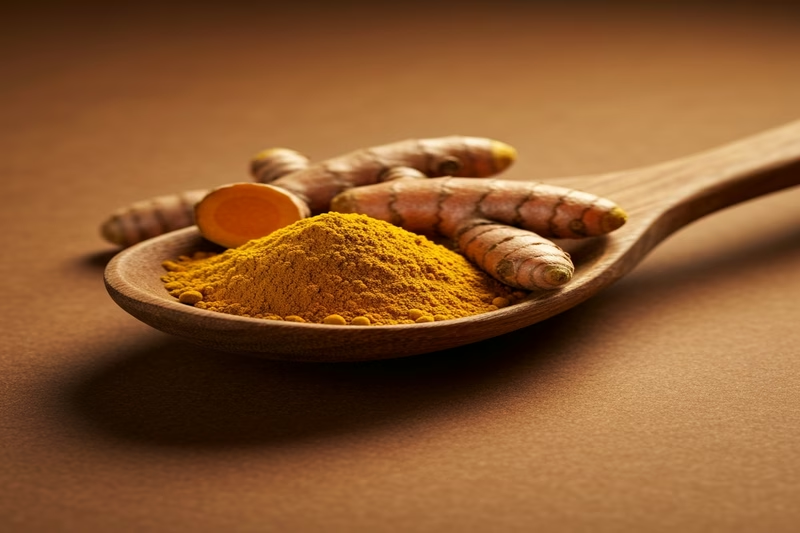
First, a critical clarification. Turmeric is the whole spice — the yellow root you find in the grocery store. Curcumin is the primary bioactive compound within turmeric, making up about 2-8% of the root by weight. Most clinical research uses concentrated curcumin extracts, not whole turmeric powder. This matters because you'd need to consume enormous amounts of turmeric spice to get the curcumin doses used in clinical trials. When we talk about 'turmeric for joint pain,' we're really talking about curcumin supplementation.
How Curcumin Works for Joint Pain
Curcumin addresses joint pain primarily through its anti-inflammatory and antioxidant mechanisms. It works on multiple molecular targets simultaneously.
- Inhibits NF-kB — a master regulator of inflammatory gene expression. When NF-kB is overactive (as it is in arthritic joints), it drives the production of inflammatory cytokines, enzymes that degrade cartilage, and pain-signaling molecules.
- Reduces COX-2 and 5-LOX activity — the same enzyme pathways targeted by NSAIDs like ibuprofen and naproxen. This reduces prostaglandin production, lowering both inflammation and pain.
- Inhibits matrix metalloproteinases (MMPs) — enzymes that break down the collagen and proteoglycan matrix of cartilage. By reducing MMP activity, curcumin may help slow cartilage degradation.
- Scavenges free radicals — oxidative stress is elevated in arthritic joints and contributes to cartilage damage. Curcumin's antioxidant capacity helps counteract this.
Importantly, curcumin modulates inflammation without the gastrointestinal and cardiovascular risks associated with long-term NSAID use — a significant advantage for people who need ongoing pain management.
What the Clinical Evidence Shows
Osteoarthritis
The strongest evidence for curcumin and joint pain comes from osteoarthritis trials. A 2021 meta-analysis published in Nutrients pooled data from 16 randomized controlled trials involving over 1,100 participants with knee osteoarthritis. The results were clear: curcumin supplementation significantly reduced pain scores (measured by WOMAC and VAS scales) and improved physical function compared to placebo. Several trials also compared curcumin directly to NSAIDs. A notable study in BMC Complementary Medicine and Therapies found that 1,500 mg of curcumin daily was as effective as 1,200 mg of ibuprofen for reducing pain in knee osteoarthritis — with significantly fewer gastrointestinal side effects.
Rheumatoid Arthritis
The evidence for rheumatoid arthritis (RA) is smaller but promising. A pilot study published in Phytotherapy Research found that curcumin (500 mg daily) was more effective than diclofenac sodium (a prescription NSAID) at reducing tender and swollen joint scores in RA patients. A 2023 systematic review concluded that curcumin supplementation appears to reduce inflammatory markers (CRP, ESR) in RA patients, though more large-scale trials are needed. Curcumin should not replace disease-modifying medications for RA, but it may serve as helpful adjunct support.
Exercise-Related Joint Pain
A 2020 meta-analysis in the Journal of the International Society of Sports Nutrition found that curcumin supplementation reduced delayed-onset muscle soreness (DOMS) and markers of exercise-induced inflammation. For active people who experience joint discomfort after workouts, curcumin may help manage exercise-related inflammation and support faster recovery.
The Bioavailability Problem (and Solutions)
Here's the biggest challenge with curcumin: on its own, it's very poorly absorbed. Standard curcumin has a bioavailability of roughly 1-2% — meaning that 98-99% of what you swallow passes through without being absorbed into the bloodstream. This is why simply adding turmeric to your food, while delicious, won't give you therapeutic doses.
Several technologies have been developed to solve this problem.
- Piperine (black pepper extract) — The simplest approach. Piperine inhibits the liver enzymes that break down curcumin, increasing bioavailability by about 2,000%. Adding 5-20 mg of piperine (BioPerine) is the most common strategy in supplements.
- Phytosome technology (Meriva) — Curcumin bonded to phospholipids (soy lecithin). Studies show 29x better absorption than standard curcumin. Used in several clinical trials with positive results.
- Nanoparticle formulations (Theracurmin) — Uses colloidal nanoparticle technology. Studies claim 27x better bioavailability. Has been used in several Japanese clinical trials.
- Micelle formulations (NovaSOL) — Uses a micelle delivery system for 185x improved bioavailability in some measurements. Allows lower doses to achieve therapeutic blood levels.
- Curcumin with turmeric essential oils (BCM-95) — Combines curcumin with the volatile oils naturally present in turmeric. Shows about 7x better absorption than standard curcumin.
Any reputable curcumin supplement should use one of these enhanced-absorption technologies. If a product uses standard curcumin powder without a bioavailability enhancer, you're likely wasting most of what you're paying for.
Dosage: How Much Do You Need?
Dosage depends heavily on the formulation. For standard curcumin with piperine, clinical trials showing benefits typically used 1,000-1,500 mg of curcumin daily, divided into 2-3 doses. For enhanced-absorption forms like Meriva, effective doses are lower — often 400-1,000 mg daily. Theracurmin and NovaSOL formulations can be effective at even lower doses (180-400 mg) due to their superior bioavailability. The key is consistency — curcumin works best when taken daily for at least 4-8 weeks. Most clinical trials run for 8-12 weeks.
Safety and Side Effects
Curcumin has an excellent safety profile across clinical trials. The most common side effects are mild gastrointestinal symptoms (nausea, diarrhea) at high doses. A few important cautions: curcumin may interact with blood-thinning medications (it has mild antiplatelet activity), it can lower blood sugar (relevant for people on diabetes medication), and it may increase bile production (caution with gallbladder disease). Pregnant and breastfeeding women should consult their doctor before supplementing. For the general population, curcumin at standard supplement doses is considered very safe.
Curcumin in Joint Supplements
Curcumin is increasingly included in comprehensive joint health formulas alongside ingredients like collagen, glucosamine, hyaluronic acid, and Boswellia. The rationale is sound — curcumin addresses the inflammatory component of joint pain, while other ingredients support cartilage structure and synovial fluid quality. Products like Joint Genesis take this multi-pathway approach to joint support. When evaluating any joint supplement containing turmeric or curcumin, check which form is used and whether a bioavailability enhancer is included.
Exploring Joint Support Options?
Curcumin is one piece of the joint health puzzle. We've reviewed comprehensive joint supplements that combine multiple evidence-backed ingredients for broader support.
See Our Joint Health Supplement ReviewsThe Bottom Line
The evidence for curcumin and joint pain is genuinely strong — stronger than for most natural compounds. Over 30 clinical trials consistently show meaningful reductions in pain and improvements in function, particularly for osteoarthritis. Some trials show curcumin performing comparably to NSAIDs with fewer side effects. The caveat is bioavailability: standard curcumin is poorly absorbed, so using an enhanced-absorption formulation is essential. At the right dose with the right formulation, curcumin is one of the most evidence-backed natural options for joint pain management. It's not a miracle cure, but for many people, it's a meaningful part of a comprehensive joint health strategy.
Frequently Asked Questions
How long does it take for turmeric/curcumin to help joint pain?
Most clinical trials show significant improvements in pain scores within 4-8 weeks of consistent daily supplementation. Some people report noticeable changes sooner, particularly if they're using an enhanced-absorption formulation. However, curcumin is not a fast-acting painkiller like ibuprofen — it works by modulating inflammatory pathways over time. Give it at least 8 weeks before deciding if it's working for you.
Is cooking with turmeric enough to get joint benefits?
Unfortunately, no. Turmeric spice contains only 2-8% curcumin by weight, and standard curcumin has very low bioavailability. You'd need to consume unrealistic amounts of turmeric powder to match the doses used in clinical trials (1,000-1,500 mg of curcumin). Cooking with turmeric is great for overall health and provides small amounts of curcumin, but for therapeutic joint benefits, a concentrated curcumin supplement with enhanced absorption is necessary.
Can I take curcumin with other joint supplements like glucosamine?
Yes, and many people do. Curcumin and glucosamine work through different mechanisms — curcumin addresses inflammation while glucosamine supports cartilage structure. There are no known interactions between them, and the combination may be more effective than either alone. Some studies have tested combinations of curcumin with glucosamine and chondroitin, showing additive benefits.
Is curcumin better than ibuprofen for joint pain?
Several clinical trials suggest curcumin is comparable to ibuprofen for osteoarthritis pain relief, with the advantage of significantly fewer gastrointestinal side effects. However, curcumin takes weeks to reach full effectiveness while ibuprofen works within hours. For acute pain, ibuprofen is faster. For long-term management, curcumin may be the smarter choice due to its better safety profile. Some people use ibuprofen for acute flares while maintaining daily curcumin for baseline inflammation management.
Get honest health tips & reviews
Join our newsletter for science-backed supplement reviews and wellness advice.
No spam. Unsubscribe anytime.