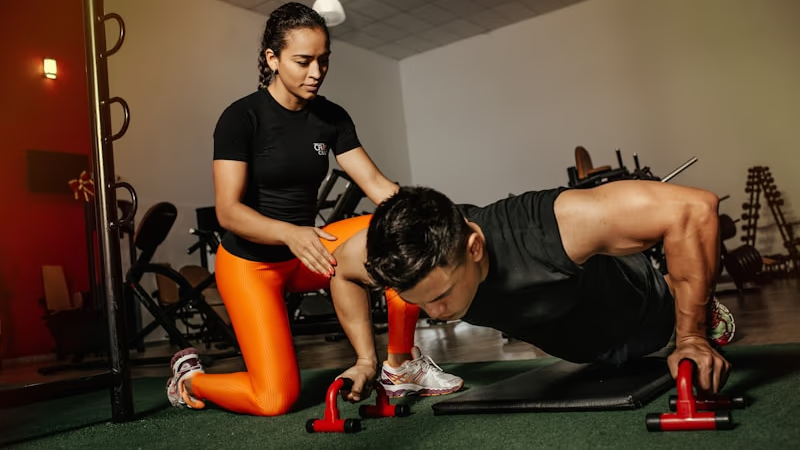

Here's a paradox that confuses many people with joint pain: the joints that hurt when you move are the same joints that deteriorate faster when you don't move. Exercise is not optional for joint health — it's essential. Cartilage has no direct blood supply. It gets its nutrients from synovial fluid, and that fluid only circulates when you move the joint through its range of motion. In other words, movement is how your joints eat. But not all movement is created equal. High-impact, poorly programmed exercise can accelerate joint wear, while the right exercises can strengthen the muscles, tendons, and ligaments that protect your joints — even in the presence of existing arthritis. Here's what the evidence supports in 2026.
Why Exercise Matters More Than Most People Think
The American College of Rheumatology, the Arthritis Foundation, and virtually every major orthopedic organization recommends regular exercise as a first-line treatment for joint pain and osteoarthritis. A 2024 Cochrane Review confirmed that exercise therapy produces clinically meaningful reductions in pain and improvements in function for people with knee and hip osteoarthritis — effects comparable to NSAIDs but without the side effects.
Exercise helps joints through multiple mechanisms: it strengthens the muscles surrounding joints (reducing direct stress on cartilage), promotes synovial fluid circulation (nourishing cartilage), maintains range of motion (preventing stiffness), reduces systemic inflammation (a driver of cartilage degradation), and helps manage body weight (every extra pound puts 4 pounds of stress on your knees). The key is choosing activities that load joints appropriately — enough to stimulate adaptation, not so much that they cause damage.
The Best Low-Impact Exercises for Joint Health
Walking
Walking is the most accessible and underrated exercise for joint health. A 2022 study in Arthritis & Rheumatology found that people with knee osteoarthritis who walked regularly had significantly less cartilage damage over four years compared to non-walkers. Walking loads the knee joint in a controlled, rhythmic way that stimulates cartilage maintenance without excessive force. Start with 15-20 minutes daily and gradually build to 30-45 minutes. Flat, even surfaces are best for beginners. Good footwear with adequate cushioning makes a meaningful difference.
Swimming and Water Aerobics
Water-based exercise is often considered the gold standard for people with significant joint pain. Water buoyancy reduces the effective load on joints by up to 90%, allowing you to exercise with minimal stress on weight-bearing joints. At the same time, water resistance provides a gentle strengthening stimulus. A study in Physical Therapy found that aquatic exercise significantly reduced pain and improved function in people with hip and knee osteoarthritis. Even simple walking in waist-deep water provides excellent exercise with dramatically reduced joint impact.
Cycling (Stationary or Outdoor)
Cycling moves your knees through a full range of motion under controlled resistance without the impact forces of running or jumping. The circular pedaling motion promotes synovial fluid circulation and gently strengthens the quadriceps — the primary muscle group protecting the knee joint. A stationary bike allows precise control of resistance and eliminates the balance demands of outdoor cycling. Start with low resistance and moderate cadence (60-80 RPM). Even 15-20 minutes three times per week produces measurable benefits.
Yoga and Tai Chi
Both yoga and tai chi combine gentle movement with flexibility, balance, and mindful body awareness. A meta-analysis in the Journal of Rheumatology found that tai chi significantly reduced pain and stiffness while improving physical function in people with osteoarthritis. Yoga offers similar benefits, with the added advantage of developing core strength and body awareness that protects joints during daily activities. Chair yoga and gentle yoga classes are good starting points if your mobility is limited. Avoid hot yoga or advanced poses that require extreme joint ranges.
Strength Training for Joint Protection
Many people with joint pain avoid strength training, fearing it will make things worse. This is one of the biggest misconceptions in joint health. Weak muscles are a primary contributor to joint pain and degeneration. When the muscles around a joint are weak, the joint itself absorbs more force during every step, squat, and stair climb. Strengthening those muscles transfers that load away from vulnerable cartilage and onto resilient muscle tissue.
Key Exercises by Joint
- Knees — Straight leg raises, wall sits, step-ups (low height), leg press (limited range), mini squats. The quadriceps are the primary protective muscle group. Focus on controlled movements without deep knee bending beyond 90 degrees if painful.
- Hips — Clamshells, lateral band walks, hip bridges, standing hip abduction. Strengthening the gluteus medius (side hip muscle) is critical — weakness here contributes to both hip and knee pain.
- Shoulders — External rotation with resistance bands, scapular squeezes, wall push-ups, light lateral raises. Rotator cuff strengthening prevents impingement and supports the most mobile joint in the body.
- Hands and wrists — Grip strengthening with a stress ball or putty, finger extensions with rubber bands, wrist curls with very light weights. Maintaining grip strength is essential for daily function.
Start with bodyweight or very light resistance and focus on higher repetitions (12-15 per set). The goal is muscular endurance and stability, not maximum strength. Increase resistance gradually — a 10% increase per week is a reasonable pace. Two to three strength training sessions per week is sufficient for joint protection.
Flexibility and Range of Motion
Maintaining full range of motion in your joints is crucial for long-term function. Stiffness begets more stiffness — when you stop moving a joint through its full range, the connective tissue tightens, further limiting movement. Gentle daily stretching of all major joint groups takes only 10-15 minutes and produces significant benefits. Focus on holding stretches for 30-60 seconds (static stretching) after exercise when muscles are warm. Dynamic stretching (controlled movement through range of motion) is best done before exercise as a warm-up.
Exercises to Approach with Caution
Not all exercise is joint-friendly, especially if you already have pain or arthritis.
- Running on hard surfaces — High repetitive impact. If you love running, soft surfaces (grass, trails) and shorter distances with adequate recovery are better options.
- Deep squats and lunges under heavy load — These place extreme compressive forces on knee cartilage. Partial range versions with moderate weight are a safer alternative.
- High-impact plyometrics (box jumps, burpees) — The landing forces can be 5-7 times body weight. Not ideal for compromised joints.
- Overhead pressing with impingement — If you have shoulder pain, overhead movements may worsen impingement. Focus on angles that don't provoke pain.
- Any exercise that causes sharp, acute joint pain during the movement — Mild discomfort that resolves quickly is generally acceptable. Sharp pain that persists is a signal to stop and modify.
Combining Exercise with Joint Support
Exercise is the foundation of joint health, but it works even better when combined with other supportive strategies. Maintaining a healthy body weight, eating an anti-inflammatory diet (rich in omega-3s, vegetables, and antioxidants), and ensuring adequate sleep for tissue recovery all multiply the benefits of exercise. Some people also find targeted joint supplements helpful alongside their exercise program — ingredients like collagen, glucosamine, and anti-inflammatory compounds like turmeric have evidence supporting their use. Products like Joint Genesis combine multiple joint-support ingredients in a single formula.
Want to Support Your Joints from the Inside?
Exercise strengthens the structures around your joints. Supplementation can support the cartilage and synovial fluid within them. See our evidence-based joint supplement reviews.
Browse Joint Health Supplement ReviewsThe Bottom Line
The worst thing you can do for painful joints is stop moving them. Exercise is not just compatible with joint health — it's the single most important thing you can do to protect, maintain, and even improve your joints. Focus on low-impact cardio (walking, swimming, cycling), consistent strength training targeting the muscles around affected joints, and daily flexibility work. Start slowly, progress gradually, and listen to your body. Mild discomfort during exercise is normal; sharp or worsening pain is a signal to modify. With the right approach, exercise becomes your joints' best medicine.
Frequently Asked Questions
Should I exercise if my joints are already in pain?
In most cases, yes — but with appropriate modifications. Major medical organizations recommend exercise as a first-line treatment for osteoarthritis-related joint pain. The key is starting gently and choosing low-impact activities. Water exercise is excellent for people with significant pain because buoyancy reduces joint loading by up to 90%. If you have acute inflammation (red, hot, swollen joints), rest that specific joint until acute inflammation subsides, but continue exercising unaffected joints.
How often should I exercise for joint health?
Most guidelines recommend at least 150 minutes of moderate activity per week (about 30 minutes, 5 days) for general health. For joint-specific benefits, aim for 2-3 strength training sessions and daily flexibility work in addition to regular low-impact cardio. Consistency matters more than intensity. Five 20-minute sessions per week is far better for joints than one 100-minute weekend session.
Is walking or swimming better for joint health?
Both are excellent, but they serve slightly different purposes. Walking provides the low-level impact that stimulates cartilage maintenance and bone density — benefits that swimming doesn't provide (since it's non-weight-bearing). Swimming offers strengthening and cardiovascular benefits with almost zero joint impact, making it ideal during flare-ups or for people with severe arthritis. The best approach combines both: walk when joints feel good, swim when they need a break.
Can exercise actually rebuild joint cartilage?
Exercise cannot regenerate significant cartilage loss, but it can help maintain existing cartilage and slow further degradation. The mechanical loading from appropriate exercise stimulates chondrocytes (cartilage cells) to maintain the matrix and promotes synovial fluid production that nourishes cartilage. Studies show that people who exercise regularly have better cartilage quality on MRI compared to sedentary people, even among those with osteoarthritis.
Get honest health tips & reviews
Join our newsletter for science-backed supplement reviews and wellness advice.
No spam. Unsubscribe anytime.