Eye Supplements, Checked Against the Actual Trials
We compared the direct-to-consumer vision formulas worth considering in 2026 against AREDS2, the only eye nutrition research that has ever moved a clinical endpoint
Best Vision Health Supplements in 2026
Night driving has quietly gotten harder. Menus in dim restaurants take an extra second. Your eyes feel like sandpaper by 5pm. None of that is a disease, and all of it is worth doing something about.
When did driving at night start feeling like work?
It is rarely a single moment. It is a slow accumulation of small adjustments you made without noticing you were making them.
You started taking the surface streets instead of the highway after dark. You moved the lamp closer to your reading chair. You hold your phone a little further away than you used to. Each adjustment was so small it never registered as a decision — and together they add up to a life that has quietly narrowed.
The frustrating part is that nothing is wrong, exactly. Your last eye exam was fine. Your prescription is current. There is no diagnosis to point at, just a general sense that your eyes are working harder than they used to for the same result.
Age-related change in the eye is not entirely a nutritional problem, but a meaningful part of it is. Macular pigment — the yellow filter of lutein and zeaxanthin sitting over your central vision — is built entirely from what you eat. Most American diets do not supply much of it.
That is the specific gap these formulas are trying to close. Not a cure, not a reversal, and not a substitute for the annual dilated exam you should be booking anyway. Just the nutrients the retina uses, at a level ordinary meals rarely deliver.
The Small Things That Add Up
None of these is dramatic on its own. Together they are why you are reading this page:
Headlight Glare That Lingers
An oncoming car passes and the bright patch stays in your vision for several seconds longer than it used to. You slow down slightly without thinking about it. Eventually you stop taking the highway after dark and tell yourself you prefer the back roads.
The Dim Restaurant Menu
You angle it toward the candle. You take your glasses off, then put them back on. Someone at the table reads it out loud and you say you forgot your readers. Low-light acuity is one of the earliest things to shift and one of the last things people mention.
Sandpaper Eyes by Five O'Clock
Nine hours at a monitor and your eyes feel dry, gritty and heavy. You blink about a third as often when you are staring at a screen, which is most of the reason. The drops help for twenty minutes.
Focus That Takes a Beat
You look up from your laptop to the far side of the room and there is a half-second of blur before things sharpen. The ciliary muscle doing that work gets less efficient with age, and screen-heavy days tire it out faster.
Squinting at Small Print
Prescription labels, ingredient lists, the fine print on a form. You have started using your phone's flashlight and camera zoom, which works, and which you would rather not have to do.
The Quiet Worry About What Comes Next
Somebody in your family had macular problems and you have not stopped thinking about it since your last appointment. That worry is worth acting on — starting with a dilated exam, not a supplement.
None of this means something is medically wrong, and if you are worried, the right first move is an eye exam rather than an order form. But if your exam came back clean and you simply want to support the nutrients your retina actually uses, that is a reasonable thing to do — and there is real research on how to do it.
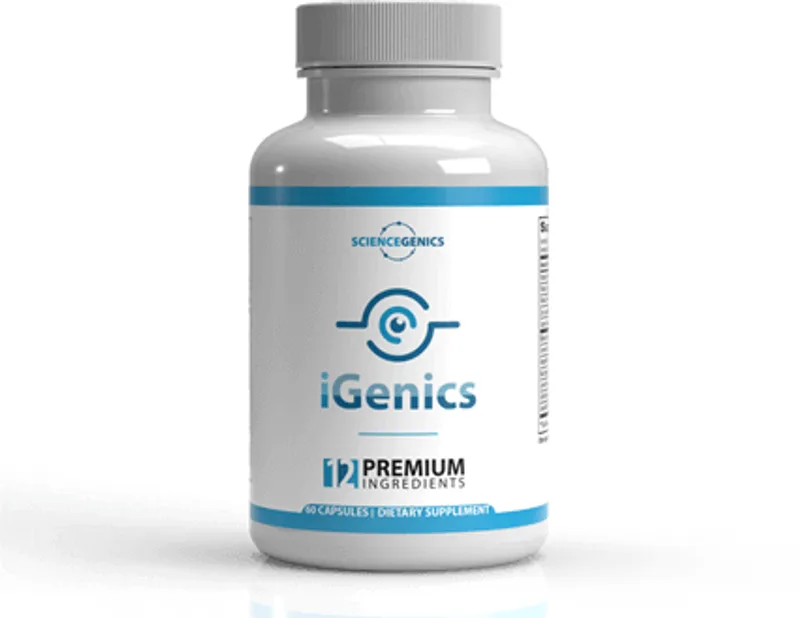
iGenics
Longest Return WindowShort twelve-ingredient AREDS2-plus-ginkgo label, a $59 single-bottle entry point, and 180 days to decide
Pros
- •180-day return window — long enough to actually test a three-month process
- •Single bottles at $59, the cheapest genuine trial in the category
- •Contains the AREDS2 nutrient core with ginkgo biloba as the named lead ingredient
- •Bilberry and saffron both included, each with their own randomised trials
- •Turmeric paired with bioperine, which suggests thought about absorption
- •Third-party tested in a GMP-certified US facility
- •On the market since 2022, giving it a longer real-world record than most rivals
Cons
- •No milligram doses published for any of the twelve ingredients
- •Two capsules daily rather than one
- •Slow refund processing is the most repeated complaint in public feedback
- •Single-bottle orders add $9.99 shipping
- •An unusual number of lookalike 'official' sites make it easy to buy from the wrong place
The Bottom Line
The sensible, unglamorous pick. A short label built on the right evidence, sold on terms that respect how long eye nutrition actually takes. If you have never tried a vision formula and want to find out cheaply whether it does anything for you, start here rather than with a bundle.
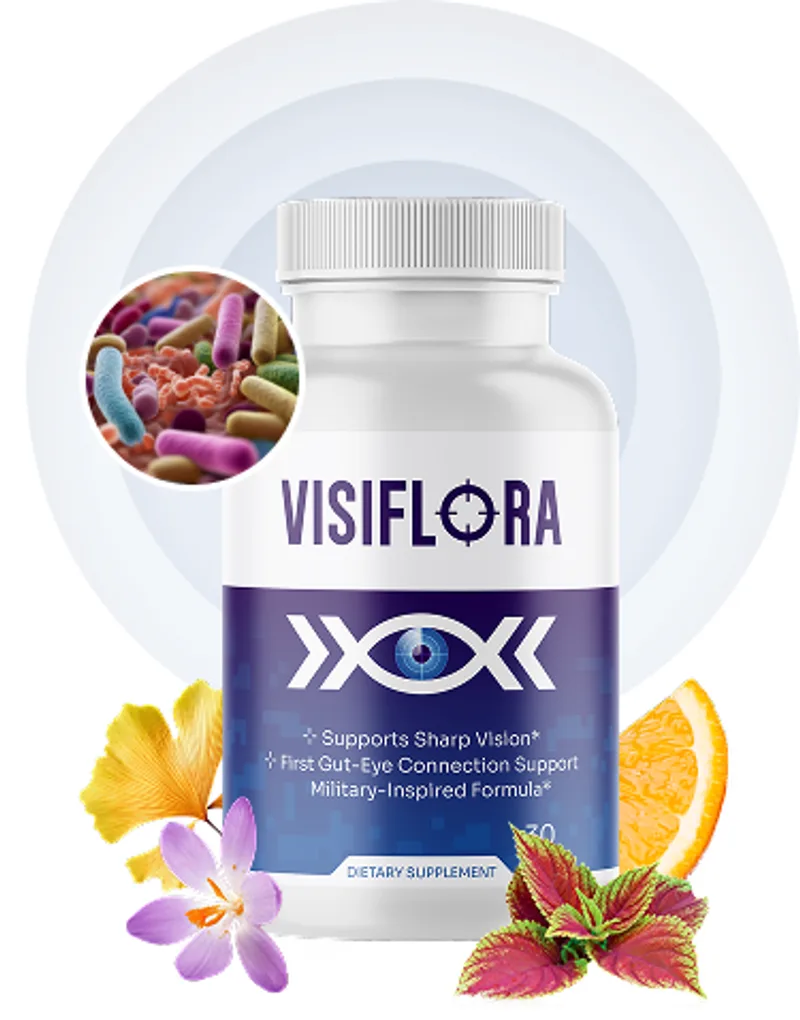
VisiFlora
Best OverallComplete AREDS2 nutrient set plus astaxanthin, bilberry and saffron — the broadest evidence-backed label in the category, in one daily capsule
Pros
- •Contains all six AREDS2 nutrients, the only eye formulation with a landmark randomised trial behind it
- •Astaxanthin, with a 2025 randomised trial on digital eye strain (Advances in Therapy)
- •Bilberry, with a 2020 randomised trial on ciliary muscle contraction (Nutrients)
- •Saffron, with randomised data on visual function in early macular change
- •Ginkgo biloba and coleus forskohlii for ocular circulation
- •One vegan capsule daily — the regimen people actually keep for three months
- •Zinc at a gentle 11mg, correctly paired with copper
- •60-day money-back guarantee, verified at the checkout page
Cons
- •Only the zinc dose is published; the other 21 ingredients have no disclosed amounts
- •Twenty-two ingredients in one capsule raises a fair dose-dilution question
- •Contains beta carotene, which AREDS2 specifically removed over the smoker signal
- •Minimum order is two bottles at $158 — no cheap single-bottle trial
- •The gut-eye sales narrative runs well ahead of the evidence
The Bottom Line
The broadest evidence-backed eye label available direct-to-consumer, in the easiest possible regimen. If your complaints are screen fatigue, dry tired eyes and night driving that has quietly gotten harder, this is the one we would start with — with the honest caveat that undisclosed doses mean you are trusting the manufacturer on amounts.
| Product | Key Benefit | Rating | Price | |
|---|---|---|---|---|
iGenics Longest Return Window | Short twelve-ingredient AREDS2-plus-ginkgo label, a $59 single-bottle entry point, and 180 days to decide | (311+) | $39.00 | Check Price |
VisiFlora Best Overall | Complete AREDS2 nutrient set plus astaxanthin, bilberry and saffron — the broadest evidence-backed label in the category, in one daily capsule | (196+) | $49.00 | Check Price |
What Readers Have Told Us
Feedback from people using VisiFlora for the ordinary, undramatic complaints this category is actually for:
"I'd stopped driving to my daughter's after dark, which she noticed before I admitted it. Around week ten I made the drive at 8pm and it was fine. Headlights still bright, but the recovery afterward wasn't the long blind spot it had been."— Ellen M., Bend, OR
"Forty years of squinting at numbers. My eyes were gritty by 4pm every day and two months on this that's mostly gone. It didn't do the dramatic thing the website promised, but it did the thing I bought it for."— Raymond T., Tulsa, OK
"I'd quit two other eye supplements because they were four capsules split across meals and I just wouldn't do it. One capsule with dinner I can manage. Six weeks in the dryness is way down."— Sandra K., Providence, RI
"My eye doctor said the ingredients were the right ones but she couldn't tell me the doses were right, which is fair. She wasn't against it. Four months in, next exam in November and I'll find out what the pictures say."— Hector V., Fresno, CA
What You Should Expect, and What You Should Not
Let us be direct, because this category attracts more overpromising than almost any other. No supplement reverses structural damage to the retina, sharpens a prescription, or replaces an eye exam. What the evidence does support is narrower and still worth having: the AREDS2 nutrient combination slowed progression of established age-related macular change in a large randomised trial, and a 2023 Cochrane review reached the same conclusion. Separate randomised trials found astaxanthin improved digital eye strain and bilberry improved ciliary muscle function. That is the honest ceiling. Both products here carry money-back guarantees — 60 days for VisiFlora, 180 days for iGenics — which means the financial risk of finding out whether they help you is genuinely small. The one thing we would ask of you regardless of what you buy: if you are over 50 and have not had a dilated eye exam in the past year, book it. That appointment catches things no capsule addresses.
How to Choose a Vision Supplement Without Getting Sold To
Four things that actually separate a good eye formula from an expensive one
- Start With the AREDS2 Six:
Lutein, zeaxanthin, zinc, copper, vitamin C and vitamin E. This is the only combination in eye nutrition tested in a large randomised trial with a clinical endpoint (JAMA, 2013), and the ten-year follow-up held up (JAMA Ophthalmology, 2022). If a formula does not contain all six, it is starting from behind — whatever else is on the label.
- Check Whether Doses Are Published:
This is where nearly every direct-to-consumer eye supplement fails, including both products here. AREDS2 used 10mg lutein and 2mg zeaxanthin. Without a supplement facts panel you cannot tell whether a product delivers that or a token sprinkle. A brand that publishes its numbers deserves your money before one that does not.
- Match the Extras to Your Actual Complaint:
Astaxanthin has randomised data specifically on digital eye strain (Advances in Therapy, 2025). Bilberry has data on ciliary muscle function, which is the focusing mechanism (Nutrients, 2020). Saffron has data on visual function in early macular change (Graefe's Archive, 2019). Buy the extras that map onto your problem rather than the longest ingredient list.
- Weigh the Return Window Against the Timeline:
Macular pigment density builds over months, not weeks. A 60-day guarantee on a process that takes 120 days is a mismatch you should notice. Either commit to buying past the window, or choose the product that gives you longer to decide.
FAQs
Do eye supplements actually work, or is this category all marketing?
Both, depending on the product. One nutrient combination has genuine landmark evidence: the AREDS2 formula of lutein, zeaxanthin, zinc, copper, vitamin C and vitamin E, tested by the National Eye Institute in a large randomised trial published in JAMA in 2013 and followed for a decade. A 2023 Cochrane review confirmed antioxidant supplementation slows progression of established age-related macular change — while noting the evidence does not support it as prevention in healthy eyes. Beyond AREDS2, astaxanthin, bilberry, saffron and ginkgo each have smaller randomised trials in specific eye outcomes. Everything else on a typical label is filler.
What is AREDS2 and why does it keep coming up?
AREDS2 was the second Age-Related Eye Disease Study, run by the US National Eye Institute. It tested whether swapping beta carotene for lutein and zeaxanthin in an antioxidant formula improved outcomes, and it did — the ten-year follow-up published in JAMA Ophthalmology in 2022 found the lutein/zeaxanthin arm slowed progression to late age-related macular change more effectively. It is the only nutritional intervention in eye health that has ever moved a clinical endpoint in a trial of that size, which is why every serious formula in this category is measured against it.
How long do vision supplements take to work?
Plan on three months minimum. Eye comfort changes — less dryness, less end-of-day fatigue — often appear inside the first month, because they come from the antioxidant group rather than anything structural. Focusing comfort follows around weeks four to eight; the bilberry ciliary muscle trial ran exactly twelve weeks. Anything involving night vision or glare recovery depends on macular pigment density, which builds over months. Judging an eye supplement at four weeks is like weighing yourself four hours into a diet.
Why should I take an eye supplement with food?
Because lutein, zeaxanthin, astaxanthin, lycopene and vitamins A and E are all fat-soluble. Taken with black coffee or on an empty stomach, a substantial portion simply passes through. Taken with a meal containing some fat — eggs, olive oil, avocado, cheese, whatever you normally eat — absorption improves significantly. This single habit probably matters more than which of these two brands you choose.
Can vision supplements replace my glasses or an eye exam?
No, and nothing in this category should be sold as if it could. These are dietary supplements intended to support normal eye health — they are not intended to diagnose, treat, cure or prevent any disease, they do not change a refractive prescription, and they do not reverse damage that has already happened. If you are over 50, an annual dilated eye exam remains the single highest-value thing you can do for your vision. Sudden vision changes, flashes of light, a curtain across your visual field or a shower of new floaters need same-day attention from an eye doctor.
Should current or former smokers avoid beta carotene in eye supplements?
It is worth a conversation with your doctor. In the original AREDS trial, high-dose beta carotene was associated with increased lung cancer risk in current and former smokers, and that finding is the specific reason AREDS2 replaced it with lutein and zeaxanthin. VisiFlora lists vitamin A as beta carotene; iGenics does not lead with it. Since neither publishes doses, the safe move for anyone with a smoking history is to ask rather than assume.
Do these supplements interact with any medications?
Both formulas contain ginkgo biloba, which has antiplatelet activity and a documented interaction with anticoagulant and antiplatelet drugs — warfarin, apixaban, rivaroxaban, clopidogrel and daily aspirin. If you take any of those, ask your prescriber before starting either product, and stop ginkgo-containing supplements roughly two weeks before scheduled surgery. That is the one genuine interaction in this category rather than a blanket disclaimer.
VisiFlora or iGenics — which should I actually buy?
VisiFlora if you want the broadest label in one daily capsule and your main complaints are screen fatigue and night driving; astaxanthin and the full 22-ingredient set are what you are paying for, and the guarantee is a tight 60 days. iGenics if you want a short twelve-ingredient label, a $59 single-bottle trial instead of a $158 bundle, and a 180-day window to decide — which happens to match how long this actually takes. Neither publishes doses, so on that count they are even.
Why VisiFlora Takes the Top Spot
It is the broadest label in the category, and breadth here is not just a marketing count — the additions are the ones with published trials.
VisiFlora contains all six AREDS2 nutrients and then layers on astaxanthin, bilberry and saffron, each of which has its own randomised placebo-controlled trial in eye function. It fits into one vegan capsule a day, which is the regimen people actually maintain for the three months this category demands, and the guarantee is a tight 60 days rather than an open-ended promise that never gets tested.
- Complete AREDS2 nutrient set: lutein, zeaxanthin, zinc, copper, vitamins C and E
- Astaxanthin, with randomised data on digital eye strain
- Bilberry, with randomised data on ciliary muscle function
- Saffron, with randomised data on visual function in early macular change
- Ginkgo biloba and coleus forskohlii for ocular circulation
- One vegan capsule daily — the easiest regimen to sustain for three months
- Zinc kept at a gentle 11mg, paired with copper as it should be
- 60-day money-back guarantee, verified at the checkout
VisiFlora
Best OverallTop Vision Health Supplements in 2026
| Criteria | VisiFlora | iGenics |
|---|---|---|
| Complete AREDS2 Nutrient Set | ||
| Lutein & Zeaxanthin from Marigold | ||
| Astaxanthin for Screen Fatigue | ||
| Bilberry & Saffron Included | ||
| Ocular Circulation Support | ||
| Once-Daily Single Capsule | ||
| Third-Party Tested | ||
| Money-Back Guarantee |