Heart Supplements, Checked Against the Trials They Borrow From
The cardiovascular formulas worth considering in 2026, measured against the nitric oxide, vitamin K2 and polyphenol research their own marketing cites
Best Heart Health Supplements in 2026
You had a number read back to you at an appointment and it was higher than last time. Nobody used the word disease. You were told to watch your salt and come back in six months. This is the category people end up in on the way home.
When did your own numbers start following you around?
Nothing hurts. Nothing is wrong, exactly. You are simply aware of something you were never aware of before.
You bought the cuff. You take a reading in the morning and sometimes again at night, and you have started noticing which readings you take twice. You read the back of the salt packet now. None of this is panic — it is just a low-level attention you did not have in your thirties.
The frustrating part is the gap. Your doctor is not treating anything yet, which is good news and also leaves you with nothing to do except wait and watch. Six months is a long time to be told to come back in.
Some of that gap is genuinely nutritional. Nitric oxide production declines with age, most American diets supply very little dietary nitrate, and vitamin K2 intake is low almost everywhere outside Japan and the Netherlands. Those are real shortfalls with real research attached.
That is the narrow thing a good formula can address. Not a cure, not a substitute for the prescription you may eventually need, and not a reason to skip the follow-up appointment. Just the nutrients the cardiovascular system uses, at amounts ordinary meals rarely provide.
The Things That Bring People to This Page
None of them is dramatic. Together they are why you are reading a supplement roundup:
A Number That Moved the Wrong Way
Not high enough to treat, just higher than last time. You were told to watch it. Nobody explained what watching it is supposed to achieve, or what you are meant to do between now and the next appointment.
Stairs That Register Now
You get to the top of two flights and you notice. It is not breathlessness and it is not pain, it is awareness. You used to arrive at the landing thinking about something else entirely.
Cold Hands and Feet That Are New
Your fingers go white in the supermarket chiller aisle. You have started keeping a cardigan at the office. Peripheral circulation is genuinely one of the first things to change and one of the last things people mention to a doctor.
A Family History You Cannot Unlearn
A parent or a sibling had the stent, the bypass, the scare. You did the maths on your own age against theirs, probably more than once, and it has sat with you ever since.
The Statin Conversation You Are Not Ready For
It was raised, gently, and you asked whether there was anything you could try first. This category is largely built out of people who were told yes, within reason, and sent home to work out what that meant.
Energy That Dips in a New Way
Mid-afternoon flatness that is not sleep and is not stress. Circulation is one plausible contributor among several, which is exactly why it is worth ruling the others out first rather than buying something.
If any of this is genuinely new, the first move is an appointment rather than an order form, and a supplement is never the answer to chest pain, breathlessness on exertion or swelling in both legs. But if your doctor has already seen your numbers and told you to work on the modifiable things, the nutrients below are a reasonable part of that work — behind exercise, sleep and sodium, never in front of them.
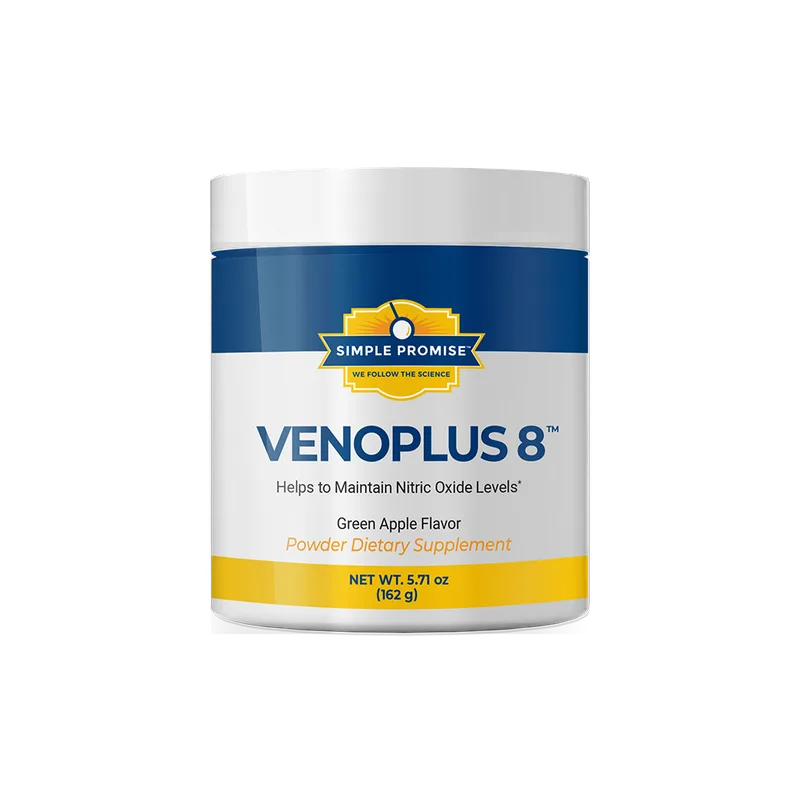
VenoPlus 8
Best OverallThe only formula covering all four cardiovascular mechanisms with branded, trial-backed ingredients — in a powder format that can physically carry them
Pros
- •Three branded, standardised ingredients with research published under their own names: MenaQ7, RedNite, Pomella
- •MenaQ7 carries a three-year randomised trial on arterial stiffness in 244 postmenopausal women
- •Covers both nitric oxide routes — dietary nitrate from beetroot and the citrulline-arginine enzymatic pathway
- •Powder format is the only one that can carry gram-scale amino acids at research amounts
- •Grape seed extract and pomegranate add polyphenol support with their own meta-analyses
- •Single jars at $59 with free US shipping and explicitly no auto-billing
- •A real company with a street address in Camas, Washington and a working phone line
Cons
- •No supplement facts panel is published anywhere, so not one of the ten doses can be verified
- •The 5.4g scoop makes research-level dosing of all ten ingredients arithmetically impossible
- •The sales page makes cardiovascular claims well beyond what a dietary supplement can support
- •The affiliate landing page carries leftover copy from other Simple Promise products
- •Slow refund processing is the most repeated complaint in public feedback
- •Official site only — no retail, no Amazon, no jar to inspect in person
The Bottom Line
The broadest evidence-backed heart formula available direct-to-consumer, in the format the category actually needs. If your doctor has seen your numbers and told you to work on the modifiable things, this is the one we would start with — as a single $59 jar, with a week of baseline cuff readings taken first, and with the honest caveat that undisclosed doses mean you are trusting the manufacturer on amounts.
| Product | Key Benefit | Rating | Price | |
|---|---|---|---|---|
VenoPlus 8 Best Overall | The only formula covering all four cardiovascular mechanisms with branded, trial-backed ingredients — in a powder format that can physically carry them | (212+) | $39.00 | Check Price |
What Readers Have Told Us
Feedback from people using VenoPlus 8 for the ordinary, undramatic reasons this category is actually for:
"I'm on a blood pressure tablet already and asked at my check-up whether this was a problem. Doctor said no, just keep logging the readings. Four months in and they're a little better, though I also started walking the dog twice a day, so I won't pretend I know which one did it."— Dennis R., Spokane, WA
"What sold me was ordering one jar instead of six. Ten weeks and my energy is steadier through the afternoon. My one complaint is that nowhere on that website does it say how much of anything is in the scoop."— Marguerite A., Fort Myers, FL
"First week my urine went pink and I nearly rang the doctor. It's the beetroot. Nobody warns you. Beyond that it's been completely uneventful, which at my age is what you want from a supplement."— Arlene P., Glendale, AZ
"Took it faithfully for eleven weeks and my home readings are where they were. No side effects, it just didn't do anything I can measure. The refund came through, but it took three weeks and two emails."— Russell M., Bozeman, MT
What You Should Expect, and What You Should Not
Let us be direct, because this is the category where overpromising does the most damage. No supplement reverses arterial plaque, replaces a statin or an antihypertensive, or makes a cardiology appointment unnecessary. Stopping a prescription because a jar arrived is the genuinely dangerous thing people do here, and it is worth saying plainly rather than in small print. What the evidence does support is narrower and still worth having: dietary nitrate, L-citrulline, pomegranate polyphenols and grape seed extract each have randomised trials showing modest measured effects on blood pressure and vascular function in adults, and MenaQ7 vitamin K2 has a three-year trial showing reduced arterial stiffness in healthy postmenopausal women. Those are real findings at specific doses, and the standing problem with this shelf — including our top pick — is that almost nobody tells you which dose you are buying. On guarantees: VenoPlus 8 advertises 365 days, and we would genuinely rather it advertised sixty and printed its supplement facts panel instead. A long window on a consumable is a marketing device; the decision you will actually make happens at week eight or twelve. Mark that date, take your readings, and act on what you find. And whatever you buy, keep the follow-up appointment — that is the part of your cardiovascular health no powder covers.
How to Choose a Heart Supplement Without Being Sold To
Four things that separate a formula built on research from one built on a story
- Insist on Published Doses:
This is the first filter and most of the category fails it, including our top pick. Citrulline trials use three to six grams a day. Beetroot trials use 200 to 800mg of nitrate. The MenaQ7 arterial stiffness trial used 180 micrograms. Without a supplement facts panel you cannot tell whether a product delivers any of that or a tenth of it, and the marketing copy reads the same either way.
- Check the Format Against the Dose:
A capsule holds roughly 500 to 800 milligrams. If a product's lead ingredients are amino acids that work at gram scale, a capsule physically cannot carry a research dose without a pill count nobody sustains. Powders and chews can. This single structural fact explains why so many people try three capsule products in this category and conclude the whole shelf is useless.
- Prefer Branded, Standardised Extracts:
MenaQ7, RedNite, Pomella and Enovita are branded materials with research published under those names. 'Beet root powder' is not. Standardisation matters especially for nitrate and polyphenol content, where the active fraction of a raw plant powder varies enormously between harvests and suppliers.
- Judge the Return Window by Your Timeline, Not Its Length:
Circulation effects show up over eight to twelve weeks. That is the window in which you will actually decide. A long guarantee on a consumable sounds generous and functions mainly as a reason not to ask for a refund today; a short one at least matches the decision you are really making. Either way, mark week eight on a calendar and act on it.
FAQs
Do heart health supplements actually work, or is this category all marketing?
Both, depending on the ingredient and the dose. Several nutrients here have genuine randomised evidence: a 2024 meta-analysis of eleven trials found beetroot juice lowered clinical systolic blood pressure by about 5 mmHg in adults with hypertension, a 2025 meta-analysis of fifteen trials found L-citrulline lowered it by about 4 mmHg in middle-aged and older adults, and a 2024 meta-analysis of 22 trials found pomegranate lowered it by about 8 mmHg with very high variability between studies. Vitamin K2 as MK-7 has a three-year trial on arterial stiffness. Those are modest, measured effects, not transformations. Whether a specific product delivers them depends entirely on whether it contains the doses those trials used, which most brands will not tell you.
What is nitric oxide and why does every product in this category talk about it?
Nitric oxide is the signalling molecule your endothelium, the inner lining of your blood vessels, uses to tell the surrounding muscle to relax. Relaxed vessels are wider vessels, and wider vessels mean easier blood flow and lower pressure against the walls. Production declines with age, which is the single most-cited rationale in this entire category. There are two routes to raising it: the enzymatic pathway, which uses L-arginine as a substrate and L-citrulline as the more absorbable precursor, and the nitrate-nitrite pathway, which runs on dietary nitrate from beetroot and leafy greens and works independently of the enzyme. A formula covering both is doing something sensible rather than something clever.
How long do heart health supplements take to work?
Plan on eight to twelve weeks before judging anything. Perceived energy and exercise tolerance are the first things people report, often inside the first month, and also the easiest to imagine. The blood pressure research behind beetroot, citrulline and pomegranate runs on a scale of weeks. Arterial stiffness is slower still — the MenaQ7 trial ran for three years. If you own a home blood pressure cuff, the useful protocol is a week of baseline readings before your first dose and another week at the eight-week mark: same arm, same time of day, seated five minutes first, averaged rather than read once.
Can I take a heart supplement with my blood pressure medication?
Usually yes, with two specific exceptions worth raising before you order. If you take nitrate medication for angina — nitroglycerin, isosorbide mononitrate or isosorbide dinitrate — stacking a nitric-oxide supplement on top can cause a dangerous drop in blood pressure, the same mechanism behind the standard warning against combining nitrates with prescription erectile medication. If you take warfarin, any vitamin K2 product directly concerns the pathway warfarin works on and you will likely need INR monitoring. Ordinary antihypertensives are a smaller issue: mention it to your prescriber, watch your home readings for a few weeks, and never stop a prescription because a supplement arrived.
Why do so few heart supplements publish their ingredient doses?
Because the amounts are frequently well below the research doses, and disclosure invites exactly the comparison this page is making. A proprietary blend lets a label name every ingredient in the literature while saying nothing about quantities, and 'contains L-citrulline' is legally satisfied by any amount above zero. When you find a brand that prints a full panel — SuperBeets publishes 500mg of beet root powder and 150mg of grape seed extract per serving, for instance — that transparency is worth real money even when the formula is narrower, because it is the only way to check the claim against the trial.
Is a powder better than capsules for heart supplements?
For this category specifically, often yes, and the reason is arithmetic rather than absorption. L-citrulline trials typically use three to six grams a day and arginine trials run higher. A capsule holds roughly 500 to 800 milligrams, so a research-level citrulline dose means six to eight capsules daily, forever, which almost nobody sustains. Capsule products therefore tend to under-dose quietly. A scoop removes that ceiling. It does not guarantee the manufacturer used the headroom — only a published panel tells you that — but it at least makes a real dose possible.
Should I take vitamin K2 if I am on a blood thinner?
Not without your prescriber's involvement. Warfarin works precisely by interfering with vitamin K-dependent clotting factors, so adding vitamin K2 changes the thing the drug is managing, and anyone combining them needs INR monitoring rather than reassurance from a website. The direct oral anticoagulants — apixaban, rivaroxaban, dabigatran — do not work through vitamin K, so the concern there is much smaller, but it is still a conversation rather than an assumption. This is the single most important medication question in the heart supplement category and it gets the least attention.
What should I do before buying anything in this category?
Three things. Get your actual numbers from your doctor rather than working from a general worry, because the plan for someone at 128 is not the plan for someone at 158. Buy a home blood pressure cuff and take a week of baseline readings, since without a baseline you will have no way to evaluate anything you spend money on. And be honest about the unglamorous interventions first: aerobic exercise, sleep and sodium reduction all have stronger evidence for endothelial function than any supplement on this page, and none of them costs $59 a month. A formula is a reasonable addition to that work. It is a poor replacement for it.
Why VenoPlus 8 Takes the Top Spot
It is the only formula we found that covers all four mechanisms with branded ingredients, in a format that can physically carry them.
Most heart supplements pick one route — a beet powder, or a K2 capsule, or an amino acid blend. VenoPlus 8 runs all of them at once: MenaQ7 vitamin K2 for arterial flexibility, RedNite beetroot for dietary nitrate, L-citrulline with L-arginine for the enzymatic nitric oxide pathway, and Pomella pomegranate plus grape seed extract for polyphenol support. Three of those are branded materials with their own published randomised trials. It arrives as a 5.4-gram daily scoop, which is the only format that can carry gram-scale amino acids, and a single jar costs $59 with free shipping.
- MenaQ7 vitamin K2, with a three-year randomised trial on arterial stiffness in 244 women
- RedNite beetroot extract, a standardised dietary nitrate source
- L-citrulline paired with L-arginine, the correct combination per the absorption literature
- Pomella pomegranate extract, standardised for punicalagins
- Grape seed extract, with randomised data on flow-mediated dilation
- Magnesium, hesperidin, taurine and vitamin C as supporting nutrients
- A 5.4g powder scoop — the only format that can carry gram-scale amino acids
- Single jars at $59 with free US shipping and no auto-billing
VenoPlus 8
Best OverallTop Heart Health Supplements in 2026
| Criteria | VenoPlus 8 |
|---|---|
| Dietary Nitrate Source | |
| Nitric Oxide Amino Acids | |
| Vitamin K2 as MK-7 | |
| Polyphenol Antioxidants | |
| Branded Standardised Ingredients | |
| Per-Ingredient Doses Published | |
| Single-Unit Trial Available | |
| Money-Back Guarantee |