
Search 'natural Viagra alternatives' and you will find lists that treat a clinically validated stack the same as a folk tea. That is a disservice. In my clinic I rank these ingredients on how much real human data sits behind them, what dose was used, and whether the safety profile holds up. The honest answer is that several natural compounds do improve erectile function in the right men, a handful have modest evidence, and some should not be on any list at all. This guide ranks them from strong evidence down to marketing only, so you can spend your money where it actually counts.
A Quick Reality Check Before We Rank
Sildenafil (Viagra) and the other PDE5 inhibitors remain the gold standard for moderate to severe erectile dysfunction, and no natural compound matches them head-to-head in trial data. That is not a reason to skip the natural route. Many men have mild to moderate ED tied to vascular tone, nitric oxide availability, low-normal testosterone, or chronic stress, and those men often respond well to targeted supplementation, with fewer side effects and a lower price tag. The goal here is to be honest about where each ingredient sits on the evidence curve.
Tier 1: Strong Evidence
L-Arginine + Pycnogenol (Pine Bark Extract)
This stack is the closest thing to a bona fide natural alternative to PDE5 inhibitors. L-arginine is a precursor to nitric oxide, which relaxes the smooth muscle that lets penile arteries dilate. Pycnogenol, a standardized pine bark extract, preserves nitric oxide by quenching free radicals that would otherwise degrade it. In the Stanislavov and Nikolova trial (2003, Journal of Sex and Marital Therapy), 40 men with ED took L-arginine 1.7 g daily for one month, then added pycnogenol 40 mg twice daily, with 80 percent restoring normal erectile function by month two and 92 percent by month three.
Typical clinical dose today: L-arginine 1.5 to 3 g per day plus pycnogenol 80 to 120 mg per day, split between two doses. Effects build over four to six weeks, not hours. Men on nitrates or with uncontrolled hypertension should clear this with a clinician first.
Panax Ginseng (Korean Red Ginseng)
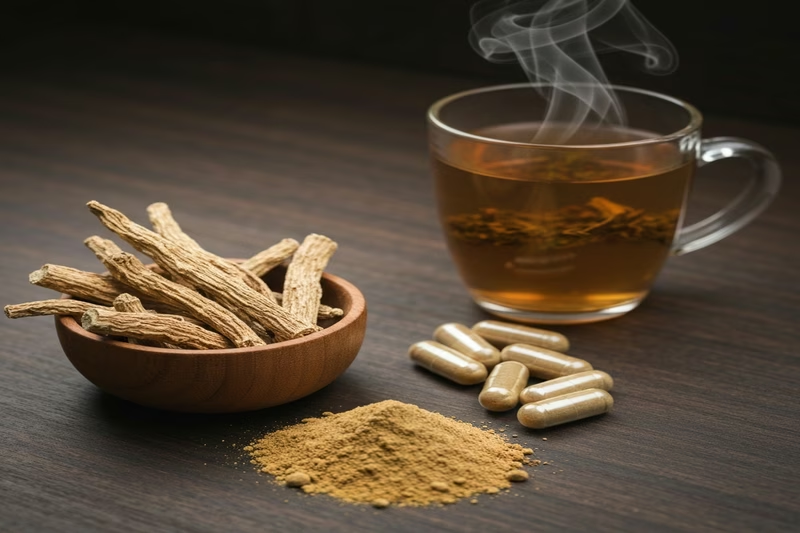
Panax ginseng is one of the few botanicals with multiple randomized controlled trials and a published meta-analysis behind it. Jang and colleagues (2008, British Journal of Clinical Pharmacology) pooled seven RCTs and found consistent improvement in International Index of Erectile Function (IIEF) scores versus placebo. The proposed mechanism is nitric-oxide-mediated corpus cavernosum relaxation plus a mild central effect on libido.
Trial doses were typically 600 to 1,000 mg three times daily of a standardized extract, which is higher than most off-the-shelf capsules. If a label says 'ginseng blend, 100 mg,' it is underdosed. Ginseng can be mildly stimulating, which is why I suggest morning or midday dosing rather than evening.
DHEA (Only If Levels Are Low)
DHEA is a precursor to both testosterone and estrogen, and it declines sharply with age. In men with documented low DHEA-S, replacement in the 25 to 50 mg per day range has improved erectile function in controlled trials. In men with normal DHEA-S, the response is unreliable and the side-effect profile (acne, hair changes, mild lipid shifts) is not worth it. This is one to test before you buy, not a general recommendation.
We ranked the top male-vitality formulas for 2026 on the strength of their core evidence-backed ingredients and real user results.
See our top male vitality supplement picksTier 2: Moderate Evidence
Maca (Lepidium meyenii)
Maca has the most consistent data for libido and sexual well-being, less so for erection quality specifically. Gonzales and colleagues (2002, Andrologia) reported improved sexual desire after eight weeks of 1.5 to 3 g daily, independent of testosterone changes, suggesting a central, non-hormonal mechanism. Subsequent work in men on SSRI-induced sexual dysfunction showed modest but real improvements. Maca is safe, well tolerated, and a reasonable add-on if desire is the main complaint, but it is not a PDE5-like vasodilator.
Tongkat Ali (Eurycoma longifolia)
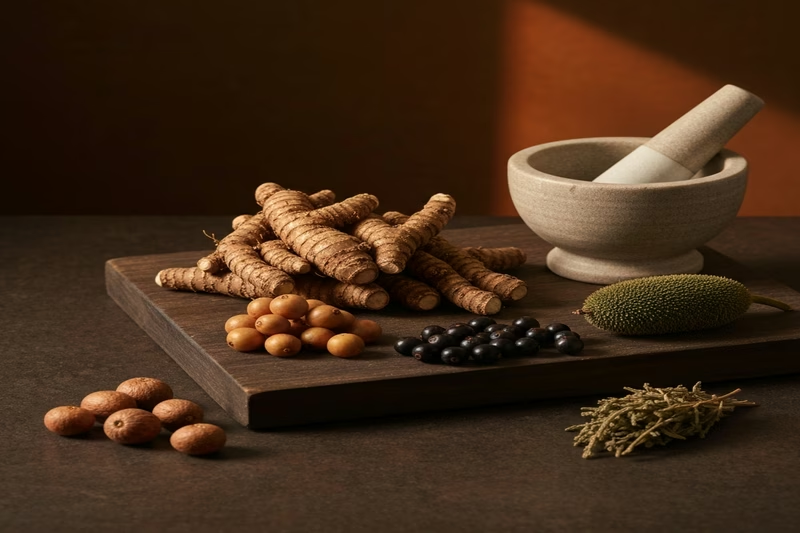
Tongkat ali has moderate evidence for raising free testosterone in men with low-normal levels, with effects on libido, mood, and energy rather than on vascular erection mechanics. Tambi and colleagues (2012, Andrologia) reported a 46 percent rise in testosterone in hypogonadal men after four weeks of 200 mg daily of a standardized water extract. It earns a Tier 2 ranking because the downstream erectile benefit is real but indirect, and the quality of commercial extracts varies widely. Look for standardization to eurycomanone content.
L-Citrulline
L-citrulline is converted to L-arginine in the kidneys and sustains nitric oxide levels more reliably than oral arginine does, because it bypasses first-pass metabolism. In a small trial of men with mild ED, 1.5 g per day improved erection hardness scores over one month. The magnitude was modest, but the tolerability was excellent. I treat citrulline as a logical pairing with arginine and pycnogenol rather than a standalone star.
Tier 3: Weak Evidence, Safety Concerns, or Both
Yohimbe / Yohimbine
Yohimbine is an alpha-2 adrenergic blocker with genuinely pro-erectile effects, but the safety profile is unkind. It can drive anxiety, jitteriness, blood pressure spikes, insomnia, and palpitations, and it interacts with several antidepressants and blood pressure medications. Pharmaceutical yohimbine hydrochloride under physician supervision is one conversation. Over-the-counter yohimbe bark extracts with unpredictable alkaloid content are another, and I do not recommend those for self-directed use.
Fenugreek
Fenugreek has a handful of small industry-funded trials showing libido and testosterone improvements, but the effect size is modest and replication outside industry-sponsored studies is thin. It is generally safe and inexpensive, so it is a reasonable adjunct, not a lead ingredient.
Tier 4: Mostly Marketing
Horny Goat Weed (Epimedium) as a Monotherapy
Icariin, the active flavonoid in epimedium, does have in-vitro PDE5 inhibitory activity. The problem is that the concentrations used in mouse and cell studies are not achievable from standard capsule doses. Human data for horny goat weed as a standalone supplement is essentially absent. It is a common filler in male-vitality blends because it sounds impressive on a label, not because it will change your results at those doses.
Tribulus Terrestris
Tribulus is a staple of 'testosterone booster' marketing with almost no human data supporting the testosterone claim. It has mild libido effects in some small trials, but as an ED intervention, it is not where I would spend the money.
What to Look For on a Label
- L-arginine dosed at 1.5 g or more per serving, not 100 mg as a sprinkle.
- Pycnogenol specifically named, not 'pine bark' without standardization.
- Panax ginseng standardized to a ginsenoside percentage, at clinically meaningful doses (ideally 500 mg or more per serving).
- Tongkat ali standardized to eurycomanone, not a generic 'root powder.'
- L-citrulline 1 g or more per serving, often paired with arginine.
- No proprietary blends that hide individual ingredient doses behind a total milligram number.
- Third-party testing, ideally NSF or USP verified, for contaminants and dose accuracy.
Who Should Skip Natural Alternatives and Talk to a Clinician
Natural alternatives are a reasonable first step for mild ED with otherwise good cardiovascular health. They are not the right first step if you have chest pain on exertion, new-onset ED after 50 without prior risk factors, abrupt loss of morning erections, or an inability to maintain an erection in any context. ED is one of the earliest signals of vascular disease. A cardiology or urology evaluation can catch it before a heart event does. The point of supplementation is to optimize the healthy system, not to paper over a disease.
How to Stack the Evidence-Backed Ingredients
If a man with mild to moderate ED and no contraindications asked me to build a stack on evidence alone, it would look like this: L-arginine 1.5 to 3 g plus pycnogenol 80 to 120 mg daily as the vascular base, Panax ginseng 600 mg standardized in the morning for central and vascular effect, and tongkat ali 200 mg if low-normal testosterone is part of the picture. Add L-citrulline 1 to 2 g if oral arginine causes GI upset. Give it eight to twelve weeks before judging response, and track it the way you would a medication, with concrete metrics like IIEF-5 score at baseline and week twelve.
Why capsule formulas often disappoint
If you have tried a nitric oxide capsule and felt nothing, the arithmetic probably explains it. L-citrulline trials use 1.5 to 6 grams a day and arginine trials 3 to 5 grams; a capsule holds a fraction of that. Powder formats are the only way to close the gap, and one product in this category is built around exactly that argument.
See whether the powder format deliversWe reviewed how Endopeak's formula compares to the evidence base above, including real ingredient doses and third-party testing notes.
Read our full Endopeak reviewThe Bottom Line
Natural alternatives to Viagra are not a myth, but they are not all created equal. The strongest evidence sits with L-arginine plus pycnogenol and Panax ginseng, with DHEA earning a spot only in men with documented low levels. Maca, tongkat ali, and L-citrulline hold up as moderate-evidence adjuncts. Yohimbe is potent but risky for self-use, and horny goat weed at over-the-counter doses is closer to a marketing claim than a treatment. If you choose to supplement, dose the Tier 1 ingredients correctly, give them real time to work, and remember that new ED after middle age is a reason to check in with a clinician, not just to restock the cabinet. If you are comparing finished products rather than single ingredients, our Endopeak vs Titan Boost comparison checks both labels against the doses described above.
Frequently Asked Questions
How long do natural Viagra alternatives take to work?
Unlike sildenafil, which acts within an hour, evidence-backed natural stacks work by improving nitric oxide availability and vascular tone over weeks. Expect four to eight weeks before judging response, and up to twelve weeks for the full effect.
Can I combine L-arginine with prescription ED medication?
L-arginine and PDE5 inhibitors both act on the nitric oxide pathway, so combining them can potentiate blood pressure drops. If you take sildenafil, tadalafil, or any nitrate, talk to your clinician before adding L-arginine.
Are natural Viagra alternatives safe long term?
The Tier 1 ingredients (L-arginine, pycnogenol, Panax ginseng) have reasonable long-term safety records at trial doses, though ginseng can interact with anticoagulants and some antidepressants. Yohimbe is the main one to avoid for sustained self-directed use.
Will natural alternatives raise my testosterone?
Tongkat ali has the best evidence for raising free testosterone, but only in men with low-normal baseline levels. L-arginine and pycnogenol work on vascular mechanisms rather than on hormones.
What is the single best natural supplement for ED?
If forced to pick one, L-arginine plus pycnogenol as a paired stack has the strongest clinical trial support, followed by Panax ginseng. The combination outperforms either alone.
Get honest health tips & reviews
Join our newsletter for science-backed supplement reviews and wellness advice.
No spam. Unsubscribe anytime.