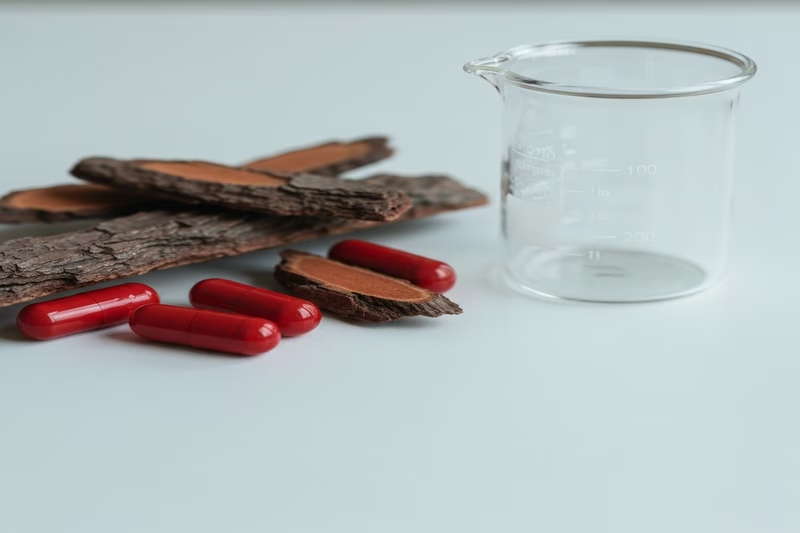

L-arginine has a reputation as a natural erection aid, and on its own that reputation is only half deserved. Most studies of L-arginine as a standalone ingredient show underwhelming or inconsistent results. There is one specific combination, though, that has held up unusually well in clinical data: L-arginine paired with Pycnogenol (a patented French maritime pine bark extract). A frequently cited trial by Stanislavov and Nikolova 2003 (Journal of Sex and Marital Therapy) reported that this combination restored functional erections in 92.5% of men after 3 months. That is a number worth understanding carefully, because the protocol details matter.
The Trial That Made This Combination Famous
Stanislavov and Nikolova (2003) recruited 40 men aged 25 to 45 with a confirmed diagnosis of mild to moderate erectile dysfunction. For the first month, men took 1.7 g of L-arginine daily with no Pycnogenol. For months 2 and 3, they added Pycnogenol, 40 mg twice daily (80 mg total). The IIEF-5 score (a standard validated questionnaire that runs from 5 to 25) moved from roughly 15 at baseline to 27 (on the IIEF full scale) by month 3, and 92.5% of men reported functional erections by the end of the 3-month window. The L-arginine-only month barely moved scores; the gain almost entirely happened after Pycnogenol was added.
That last point is the one most people miss. L-arginine by itself did little. Pycnogenol amplified it dramatically. Understanding why requires a quick detour into nitric oxide.
Why the Combination Works (and L-Arginine Alone Often Doesn't)
Erections depend on nitric oxide (NO). Inside the vascular endothelium, an enzyme called endothelial nitric oxide synthase (E-NOS) converts L-arginine into NO, which relaxes smooth muscle in the penile arteries and allows blood to fill the corpora cavernosa. In theory, more substrate (L-arginine) should mean more NO. In practice, oral L-arginine is heavily metabolized in the gut and liver (Schwedhelm 2008, British Journal of Clinical Pharmacology), and baseline E-NOS activity in middle-aged men is often blunted by oxidative stress and endothelial aging.
Pycnogenol solves the second problem. It upregulates E-NOS activity and provides potent antioxidant protection for the endothelial cells where NO is produced (Rohdewald 2002, International Journal of Clinical Pharmacology and Therapeutics). In other words, L-arginine provides the raw material and Pycnogenol turns the factory back on. Alone, each is modest. Together, they are a genuine synergy rather than a marketing one.
The Clinical Protocol, Exactly
Dosing
The trial-replicating dose is 3 g of L-arginine daily (later trials have used 1.7 to 3 g) plus 80 to 120 mg of Pycnogenol daily, split into 2 doses. Most men tolerate 3 g of L-arginine without GI upset if they split it (1.5 g twice per day). Pycnogenol is typically 40 mg twice daily or 60 mg twice daily at the higher end.
Timing
L-arginine is best absorbed on an empty stomach. First thing in the morning and mid-afternoon (at least 2 hours after a meal) is the practical slot. Pycnogenol can be taken with or without food; most people take it alongside L-arginine for simplicity.
Expected Timeline
The 2003 trial measured outcomes at 1, 2, and 3 months. The gains were progressive: modest change by week 4, meaningful change by week 8, and the headline 92.5% number by week 12. Do not judge this protocol before 8 weeks. Rating for the combination: 4.2 out of 5 for men with mild-to-moderate ED and no cardiovascular contraindications.
Why L-Citrulline Is Often the Better Substrate
One update worth knowing: more recent formulas often swap L-arginine for L-citrulline, which is the amino acid the body uses in the kidneys to recycle back into L-arginine. L-citrulline bypasses first-pass metabolism in the gut, producing a higher and more sustained L-arginine blood level than an equivalent dose of L-arginine itself. Typical L-citrulline dose is 3 to 6 g. If you see a formula that pairs L-citrulline with Pycnogenol, that is not a downgrade, it is often a mechanistic upgrade.
Format matters as much as substrate here, because gram-scale amounts do not fit comfortably into a capsule. Our Endopeak vs Nitric Boost Ultra comparison is the clearest illustration: a capsule that covers more ground at smaller amounts, against a powder that has room to deliver a gram-scale dose.
What to Look for on a Label
- The form of Pycnogenol matters. Look for the branded word 'Pycnogenol,' not 'pine bark extract,' which is often a lower-grade product with uncertain bioavailability.
- Total daily L-arginine of at least 1.7 g, ideally 3 g. If the label shows a proprietary blend without the L-arginine dose specified, assume it is underdosed.
- Pycnogenol at a minimum of 40 mg per day, with 80 mg as the clinically replicated dose.
- L-citrulline as an alternative substrate is acceptable and often superior at 3 to 6 g.
- Absence of fillers, proprietary blends, or artificial stimulants. This is not a pre-workout; it is a vascular supplement.
- Third-party testing (NSF, USP, or Informed Sport) for purity. L-arginine is cheap, so there is rarely a reason a quality supplement skips verification.
Look for a men's vitality formula that combines L-arginine or L-citrulline with Pycnogenol (or a comparable NO-supporting antioxidant) rather than isolated L-arginine on its own.
See our top male vitality supplement picksWho Should Think Carefully Before Using This Protocol
L-arginine is generally well tolerated, but the NO pathway is a real pharmacological lever and it interacts with a few things. Talk to a clinician first if any of these apply.
- You are on antihypertensive medication. Additional NO production can compound the blood-pressure lowering effect.
- You have low resting blood pressure or a history of orthostatic hypotension.
- You are on PDE5 inhibitors (Viagra, Cialis). Stacking is possible but should be supervised because both pathways amplify NO signaling.
- You have a history of recurrent herpes simplex outbreaks. L-arginine can, in some individuals, favor viral replication; lysine balance has been discussed clinically though evidence is mixed.
- You have had a recent heart attack or unstable cardiovascular disease. NO modulation in that setting deserves a cardiologist's input.
- You are on nitrate medications (isosorbide, nitroglycerin). This is a hard no, the combined blood-pressure drop can be dangerous.
Realistic Expectations and What This Won't Do
The Stanislavov and Nikolova 2003 trial was in men with mild to moderate ED. The combination is not a replacement for PDE5 inhibitors in severe ED, and it does not address the hormonal side of the equation (testosterone, DHEA, thyroid). If your issue is primarily hormonal, you will need to pair this vascular stack with something targeting the hormonal side (ashwagandha, Tongkat Ali, sleep, strength training, body composition). That is one reason multi-mechanism formulas tend to outperform single-ingredient products.
Endopeak combines L-citrulline-style NO support with ingredients targeting the hormonal side in one capsule. Worth comparing to a pieced-together stack.
Read the full Endopeak reviewStacking This With Other Natural Support
If you want to build a complete vascular-and-hormonal stack, the sensible additions are: zinc (15 to 25 mg daily) for testosterone synthesis, magnesium glycinate (300 to 400 mg) for sleep and vascular tone, vitamin D3 (2,000 to 4,000 IU if deficient), and ashwagandha KSM-66 (600 mg) for cortisol control. Add Tongkat Ali at 200 to 400 mg if free T is genuinely low. That gives you the substrate, the cofactors, the hormone support, and the stress modulation all at once.
How to Tell If It Is Working
The dose problem with capsules
Everything on this page depends on gram-scale amounts, and that is exactly where most supplements quietly fail: a capsule holds 500 to 800mg, so a research-level citrulline dose would mean swallowing six to eight of them daily. One product in this category sidesteps the constraint by shipping as a powder instead — which is the right answer to a problem most brands pretend does not exist.
Read the Nitric Boost Ultra reviewThree practical markers: morning erection frequency, time-to-arousal, and erection rigidity during intercourse. Most men who respond notice morning erections returning first, usually by week 6, followed by better daytime responsiveness. If at week 12 nothing has changed across any of those three markers, you are either in the non-responder minority, the dose was too low, the brand of Pycnogenol was weak, or another driver (hormonal, psychological, or pharmacological) needs attention.
The Bottom Line
L-arginine alone is a mediocre ED supplement. L-arginine (or L-citrulline) paired with Pycnogenol at clinically replicated doses, however, has some of the cleaner supporting data in the natural-ED space, most notably the Stanislavov and Nikolova 2003 trial showing roughly 92.5% of men reporting functional erections by month 3. The protocol is cheap, the mechanism is well characterized, and the combination is tolerable for most men. If you are going to try this route, do it with the right doses (3 g L-arginine or L-citrulline plus 80 mg Pycnogenol), give it a full 8 to 12 weeks, and check with a clinician first if you are on antihypertensives, PDE5 inhibitors, or nitrates. Done right, this is one of the best evidence-backed natural plays available. If you would rather buy a finished formula than assemble the doses yourself, our Boostaro vs Endopeak comparison looks at two products built around this exact pathway.
Frequently Asked Questions
How long does L-arginine and Pycnogenol take to work?
Most men notice meaningful improvement between week 6 and week 12. The Stanislavov and Nikolova 2003 trial measured its headline 92.5% functional-erection result at the 3-month mark. Do not judge the protocol before 8 weeks.
Is L-citrulline better than L-arginine?
Often yes, for oral dosing. L-citrulline bypasses first-pass metabolism and produces higher, more sustained L-arginine blood levels than an equivalent oral dose of L-arginine itself. A 3 to 6 g dose of L-citrulline is roughly equivalent to a higher oral dose of L-arginine in NO effect.
Can I take L-arginine with Viagra or Cialis?
Technically possible but should be supervised by a clinician. Both pathways amplify nitric oxide signaling, and blood pressure needs monitoring. Never combine L-arginine with nitrate medications (nitroglycerin, isosorbide); that interaction can be dangerous.
What form of Pycnogenol should I look for?
Look for the branded word 'Pycnogenol,' which refers to the standardized French maritime pine bark extract with the bulk of the clinical evidence. Generic 'pine bark extract' is not necessarily equivalent and is often lower grade.
Does L-arginine and Pycnogenol work for severe ED?
The original clinical data was in men with mild to moderate ED. In severe ED, this combination alone is unlikely to be sufficient, though it can be a useful adjunct alongside PDE5 inhibitors under clinician supervision. Addressing the hormonal and psychological drivers in parallel matters.
Are there side effects to watch for?
L-arginine can cause mild GI upset at doses above 3 g, which usually resolves by splitting the dose. Pycnogenol is very well tolerated. The main concerns are drug interactions: antihypertensives, PDE5 inhibitors, and especially nitrates. Men with low resting blood pressure or a history of herpes simplex outbreaks should also discuss with a clinician first.
Get honest health tips & reviews
Join our newsletter for science-backed supplement reviews and wellness advice.
No spam. Unsubscribe anytime.