
Most women who walk into my practice with new joint pain in their late 40s or early 50s have already been told it is just aging. Sometimes it is. Often it is something more specific: menopausal arthralgia, a hormonally driven joint pain syndrome that is well documented in the research literature and almost never explained to the women experiencing it. The prevalence is striking. Somewhere between 50 and 60 percent of perimenopausal and early postmenopausal women develop new or worsening joint pain, and the mechanism is more specific than general wear and tear. Understanding it changes what you do about it.
What Menopausal Arthralgia Actually Is
Magliano and colleagues (2010, Menopause) reviewed the prevalence and pattern of joint pain in the menopausal transition and found that arthralgia is one of the most common but least acknowledged symptoms, affecting roughly half of women. The pattern is specific: small joints of the hands (especially the proximal interphalangeal joints), knees, hips, and shoulders are the most commonly affected. Morning stiffness that eases with movement is typical. The pain often migrates between joints and can flare with hormone fluctuations.
The Estrogen-Collagen Mechanism
Estrogen and Collagen Synthesis
Estrogen receptors are present throughout connective tissue, including cartilage, ligaments, tendons, and synovium. Estrogen supports collagen synthesis at a cellular level, and its decline reduces both the quantity and quality of collagen turnover. Women lose approximately 30 percent of skin collagen in the first five years after menopause, and a similar loss likely occurs in other collagen-rich tissues, including joint cartilage and periarticular structures.
Estrogen and Inflammation
Estrogen is also immunomodulatory, and its decline shifts the cytokine balance in synovial tissue toward a more inflammatory profile. IL-6 and TNF-alpha rise, which contributes to the morning stiffness and achy pattern that defines menopausal arthralgia. This is not inflammatory arthritis in the rheumatoid or autoimmune sense, but it is a mild low-grade inflammatory pattern that behaves differently from simple osteoarthritis.
Why the Pattern Feels Weird
Women often describe menopausal joint pain as weird because it does not match what they expected from age-related wear. It migrates. It can be bilateral and symmetric (which is unusual for osteoarthritis). It fluctuates with the cycle in perimenopause. It often comes with stiffness on waking that eases within 30 to 60 minutes of moving. These features overlap with early inflammatory arthritis, which is part of why the pattern deserves a careful clinical evaluation rather than self-diagnosis.
What Actually Helps Menopausal Arthralgia
1. Collagen Peptides, 10 to 15 Grams Daily
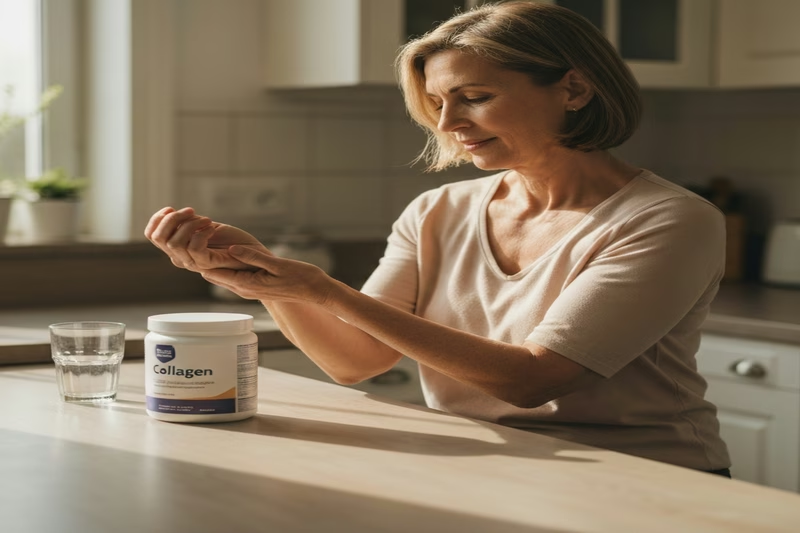
Hydrolyzed collagen peptides are the most direct nutritional support for the underlying mechanism. Clark and colleagues (2008, Current Medical Research and Opinion) conducted a 24-week trial of 10 grams daily of collagen hydrolysate in athletes with joint pain and found significant improvements in joint comfort scores. McAlindon and colleagues (2011, Osteoarthritis and Cartilage) demonstrated measurable changes in cartilage composition after collagen supplementation. The dose in the research is 10 to 15 grams daily of unflavored type I and III hydrolyzed collagen peptides, mixed into coffee or a smoothie. Give it at least 8 to 12 weeks.
2. Curcumin with Piperine, 500 to 1000 mg Daily
Curcumin, the active compound in turmeric, has a reasonable body of evidence for joint pain. Daily and colleagues (2016, Journal of Medicinal Food) published a meta-analysis of curcumin trials in osteoarthritis and found pain and function improvements comparable to low-dose NSAIDs without the GI profile. Bioavailability is the catch: plain turmeric powder is poorly absorbed, so look for formulations with piperine (black pepper extract), phytosomal curcumin, or Meriva to get a usable dose. Typical effective dose is 500 to 1000 mg of standardized curcumin daily with a fat-containing meal.
3. Omega-3 EPA + DHA, 1 to 2 Grams Daily
Calder (2017, Biochemical Society Transactions) reviewed omega-3 and inflammation and confirmed that EPA and DHA modulate cytokine production and resolve inflammatory pathways through specialized pro-resolving mediators. In joint pain specifically, the effect is modest but consistent across trials. Target 1 to 2 grams of combined EPA and DHA daily from fish oil, krill oil, or algae-based DHA/EPA. Fatty fish twice a week provides a reasonable dietary base.
4. Magnesium
Magnesium supports muscle relaxation and is often underappreciated in the joint pain picture because tense periarticular muscles amplify joint discomfort. Magnesium glycinate, 200 to 400 mg in the evening, supports both sleep and muscle relaxation, and many women report a reduction in both joint and muscle tension within a few weeks.
5. Weight-Bearing and Resistance Exercise
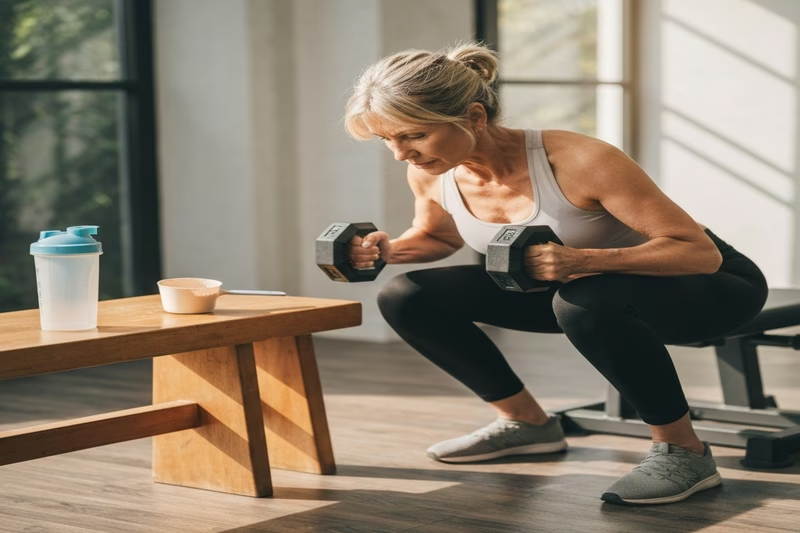
This is the intervention that matters most and that women most often avoid when joints hurt. Strength training two to three times a week, starting gently and progressing, loads joints in a way that stimulates cartilage turnover and strengthens the periarticular musculature that supports joint alignment. Women who rest aching joints for months usually feel worse, not better. Women who build a sensible strength program almost always feel better within 8 to 12 weeks.
The Stack, Put Together
- Collagen peptides 10 to 15 grams daily, mixed into any beverage.
- Curcumin 500 to 1000 mg daily with a fat-containing meal, in a bioavailable form (phytosome, piperine, or Meriva).
- Omega-3 EPA + DHA 1 to 2 grams daily, ideally alongside fatty fish in the diet twice a week.
- Magnesium glycinate 200 to 400 mg in the evening for muscle relaxation and sleep support.
- Strength training two to three times a week, starting gently and progressing over months.
- Adequate protein (1.2 to 1.6 grams per kilogram of body weight daily) to support collagen synthesis and muscle maintenance.
- Give the full stack 8 to 12 weeks before evaluating. Joint tissue remodels slowly.
When Joint Pain Deserves a Rheumatologist
Menopausal arthralgia overlaps in presentation with early inflammatory arthritis, particularly rheumatoid arthritis, which also has a peak onset in women in their 40s and 50s. The overlap is why a thoughtful evaluation is worth doing rather than assuming every new joint pain is hormonal. Red flags that warrant a rheumatology referral include the following.
- Morning stiffness lasting longer than 60 minutes, particularly if it improves only slowly through the day.
- Visible swelling, warmth, or redness in any joint, which is unusual in menopausal arthralgia.
- Symmetric joint involvement that progresses rather than fluctuates.
- Systemic symptoms: fatigue out of proportion to menopause, unintentional weight loss, low-grade fevers, or a new rash.
- Elevated inflammatory markers (ESR, CRP) on basic bloodwork, or a positive rheumatoid factor or anti-CCP antibody.
- Family history of rheumatoid arthritis, psoriatic arthritis, or lupus.
- Progressive joint deformity or significant loss of range of motion.
What About Hormone Therapy for Joint Pain
Some women with menopausal arthralgia do experience meaningful joint pain relief on systemic hormone therapy, and this is documented in observational and some randomized data. The effect is not universal, and joint pain is not by itself an indication for HRT, but for women who are considering HRT for vasomotor symptoms and who also have arthralgia, the joint component often improves. This is a conversation with a menopause-literate clinician in the context of broader risk-benefit, not a standalone reason to start hormone therapy.
For a complete breakdown of the top joint-support supplements we have reviewed in 2026, including collagen, curcumin, glucosamine, and combination formulas, our master ranking is the deepest resource.
For joint-specific support, our full breakdownWhat Does Not Help As Much As You Might Expect
Glucosamine and chondroitin, the classic joint supplement pairing, have mixed evidence in osteoarthritis and very limited data in menopausal arthralgia specifically. They are safe and inexpensive, but if cost is a consideration, collagen peptides and curcumin have stronger evidence for this pattern. CBD for joint pain is widely marketed, and while tolerability is good, the clinical evidence in joint pain is modest and quality control varies enormously. Topical NSAIDs (diclofenac gel) can help acutely when a particular joint is flaring, with much lower systemic exposure than oral NSAIDs.
Weight, Load, and the Knees
The single most impactful intervention for knee arthralgia in midlife women is weight distribution, not weight loss per se. Every 5 kilograms of body weight translates to roughly 20 kilograms of load on the knees during walking. For women with knee-predominant menopausal arthralgia, working on body composition (more muscle, less visceral fat) produces more measurable relief than any supplement. This is one of the reasons the strength training component of the plan matters so much.
The Hand Joint Pattern Specifically
Women often become alarmed when the small joints of the fingers start to ache and enlarge in their early 50s. Some of this is early hand osteoarthritis (Heberden and Bouchard nodes), which is more common in women and has a hormonal component. Some is menopausal arthralgia without structural change. Hand exercises, warm water soaks, topical diclofenac for flares, and the systemic stack above all help. Persistent swelling, particularly at the knuckles (metacarpophalangeal joints), deserves rheumatology evaluation to rule out early rheumatoid arthritis.
If joint pain is one of several menopausal symptoms rather than your only complaint, a broader menopause supplement plus a targeted joint stack is often more efficient than either alone. Our full menopause supplement guide covers how to layer them.
Our broader menopause supplement guideA Reasonable Plan If You Are Aching Right Now
If you are in the 50 to 60 percent of women with menopausal arthralgia and you are looking at a practical sequence, start with bloodwork through your primary care clinician: CBC, ESR, CRP, rheumatoid factor, anti-CCP, TSH, and vitamin D. If those are normal and the pattern fits menopausal arthralgia, begin the four-pillar supplement stack (collagen, curcumin, omega-3, magnesium) alongside a gentle strength program. Reevaluate at 8 to 12 weeks. Most women see meaningful improvement in that window. If you do not, or if any of the red flags above are present, escalate to rheumatology rather than pushing on with supplements alone. The point is to catch the small percentage of women whose joint pain is the first sign of something treatable by medication, not to miss them in a sea of menopausal arthralgia.
The Bottom Line
Menopausal arthralgia is common, specific, and almost never explained to the women who have it. The estrogen-collagen-inflammation mechanism is real, and the interventions that address it (collagen peptides, curcumin, omega-3, magnesium, and above all, strength training) have meaningful evidence behind them. Most women improve substantially within 8 to 12 weeks of a thoughtful plan. The minority whose pain turns out to be early inflammatory arthritis deserve prompt rheumatology evaluation, which is why the red flags matter. Give your joints the support they are asking for, and give your muscles the work they need to carry the load your cartilage no longer can alone.
Frequently Asked Questions
Is menopausal joint pain the same as osteoarthritis?
Not quite. Osteoarthritis is a structural wear pattern that may or may not overlap with menopausal arthralgia, which is a hormonally driven soft-tissue and low-grade inflammatory pattern. The two often coexist in women in their 50s. The implication is that menopausal arthralgia often responds to interventions that do not help pure osteoarthritis, including hormone therapy and collagen support.
How long before collagen peptides make a difference?
Give them 8 to 12 weeks at 10 to 15 grams daily. Joint tissue remodels slowly, and shorter trials often stop before the benefit is visible. Consistency and dose matter more than the brand, assuming you are using unflavored hydrolyzed type I and III collagen peptides.
Do I need the whole stack, or can I pick one?
You can start with collagen alone, which has the most direct evidence. But the stack addresses different mechanisms: collagen for structural support, curcumin and omega-3 for inflammation, magnesium for muscle tension. Women with broader symptoms usually do better with the layered approach.
Is turmeric or curcumin better?
Curcumin is the active compound in turmeric, but it is poorly absorbed. A standardized curcumin extract with piperine, a phytosome form, or Meriva is what delivers a clinically meaningful dose. Plain turmeric in food is a reasonable background but not sufficient for the joint pain goal.
Should I avoid exercise when joints hurt?
Not usually. Resting aching joints for weeks typically makes things worse. Gentle, progressive strength training supports cartilage and the periarticular muscles that stabilize joints. Modify intensity around flares, but keep moving. Swimming, cycling, and bodyweight training are all good starting points.
Can hormone therapy help my joints?
Sometimes, and this is documented in observational and some randomized data. Joint pain alone is not a standalone reason to start HRT, but for women already considering HRT for vasomotor symptoms, joint improvement is a common bonus. It is a conversation with a menopause-literate clinician.
Get honest health tips & reviews
Join our newsletter for science-backed supplement reviews and wellness advice.
No spam. Unsubscribe anytime.