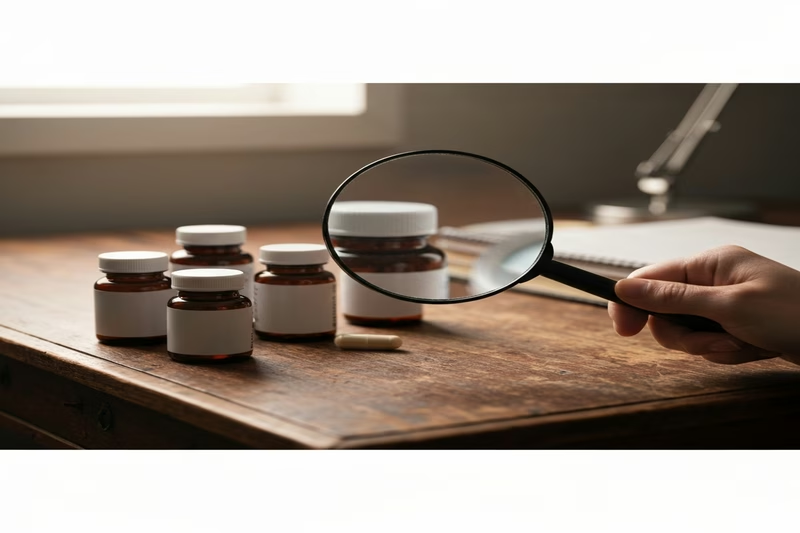

The supplement industry generates over $59 billion annually in the US alone, and reviews are one of the primary tools consumers use to decide what to buy. Unfortunately, that also makes reviews a primary target for manipulation. A 2021 study by the World Economic Forum estimated that 4% of all online reviews are fake — but in categories like supplements, where products are sold primarily online and profit margins are high, the rate is significantly higher. The FTC has taken enforcement action against dozens of companies for fake reviews and deceptive endorsements in the health and wellness space. This guide will teach you to identify fabricated reviews, understand how fake review operations work, and develop a reliable process for evaluating supplements based on trustworthy information.
Why Fake Supplement Reviews Are So Common
The supplement industry has a perfect storm of conditions that incentivize fake reviews. First, most supplements are sold online — often through a brand's own website — where the company controls which reviews appear. Second, supplements are experience goods: you can't evaluate them before buying, so you depend heavily on other people's reported experiences. Third, the profit margins on supplements are enormous — a product that costs $3-5 to manufacture often sells for $50-70, making it economically rational for unscrupulous sellers to invest heavily in fake social proof.
Add to this the fact that supplement effects are subjective and variable. Unlike a laptop or a pair of shoes, where a defective product is objectively identifiable, a supplement that "doesn't work" could be attributed to individual body chemistry rather than product quality. This subjectivity makes fake positive reviews harder to disprove and gives manufacturers plausible deniability.
The 10 Red Flags of Fake Supplement Reviews
Based on FTC enforcement data, academic research on deceptive reviews, and our own experience evaluating hundreds of supplement products, here are the most reliable indicators that reviews may be fake or manipulated.
- 1. Extreme, rapid results: "I lost 30 pounds in 2 weeks!" — Legitimate supplements produce gradual, modest results. Research consistently shows that even effective weight loss supplements add 3-8 pounds of loss over several months. Any review claiming dramatic, rapid transformation is almost certainly fabricated or sponsored.
- 2. Generic, vague language: Fake reviews often read like ad copy — "This product changed my life!" "Best supplement I've ever tried!" — without specific, personal details. Real users describe their specific experience: dosing schedule, how long before they noticed changes, what side effects they experienced, how it compared to other products they've tried.
- 3. No mention of negatives: Every legitimate product has downsides — taste, price, capsule size, time to see results, minor side effects. A review that mentions zero negatives is a red flag. Real users almost always note at least one thing they wished were different.
- 4. Reviewer has no other review history: On platforms like Amazon, check the reviewer's profile. Fake review accounts often have reviews only for products from one brand, or they posted dozens of 5-star reviews in a short time period across unrelated categories.
- 5. Suspiciously similar writing patterns: When multiple reviews for the same product use similar sentence structures, vocabulary, or talking points, they were likely written by the same person or generated from a template. Real reviews from real people have distinctly different writing styles.
- 6. Stock photo profile pictures: Reverse image search profile photos using Google Images or TinEye. Fake review accounts frequently use stock photos or AI-generated faces. Real users either don't include photos or use obviously personal images.
- 7. Reviews appear only on the seller's website: If a product has hundreds of glowing reviews on its own site but no presence on independent platforms (Amazon, Reddit, Trustpilot), question those reviews. Companies can and do fabricate testimonials on their own domains.
- 8. Identical review dates: A cluster of reviews all posted within the same 24-48 hour window often indicates a coordinated fake review campaign, especially for a product that isn't new.
- 9. Reviews focus on the ordering experience, not the product: "Fast shipping!" "Great customer service!" These are often filler reviews designed to boost star ratings without making specific claims about product efficacy that might attract regulatory attention.
- 10. Unverified purchase status: On Amazon and similar platforms, "Verified Purchase" means the reviewer actually bought the product through that platform. Unverified reviews carry less weight — though even verified reviews can be incentivized.
How Fake Review Operations Actually Work
Understanding the mechanics helps you recognize the patterns. Fake supplement reviews come from several distinct sources, each with its own fingerprint.
Review farms: Companies hire workers — often overseas — to create fake accounts and write reviews to specification. These operations charge $5-25 per review and can generate hundreds of reviews in days. The FTC shut down several major review farms in 2023 and 2024, but new ones constantly emerge. Review farm content tends to be grammatically awkward, overly enthusiastic, and lacking in product-specific detail.
Incentivized reviews: The company offers free product, discounts, or direct payment in exchange for reviews — typically positive ones. While Amazon and other platforms prohibit incentivized reviews (unless clearly disclosed), enforcement is difficult. These reviews are technically from real users but are heavily biased by the incentive.
AI-generated reviews: With the rise of large language models, AI-generated fake reviews have become a growing concern. A 2023 study from Cornell University found that AI-generated product reviews were rated as more helpful and convincing than human-written fake reviews. These are harder to detect because the language is more natural, but they still tend to lack the specific, personal details that characterize genuine user experiences.
Affiliate-driven fake reviews: Some supplement affiliate programs pay commissions of 50-75% per sale. This creates a financial incentive for affiliates to publish fake "review" websites that appear independent but exist solely to drive purchases. These sites typically rank every product highly, lack any genuine testing methodology, and include aggressive calls-to-action.
What Legitimate Supplement Reviews Look Like
Knowing what fake reviews look like is only half the equation. You also need to recognize what genuine, trustworthy supplement evaluation looks like — whether from individual consumers or professional review sites.
- Specific timelines: Real reviewers describe how long they used the product before noticing effects — typically weeks to months, not days.
- Mixed sentiment: Honest reviews include both positives and negatives. A reviewer might love the results but dislike the price, or appreciate the ingredients but find the capsules too large.
- Personal context: Genuine reviews mention the reviewer's situation — their age range, what they were trying to address, what else they've tried, their baseline health status.
- Realistic expectations: Real users describe modest, gradual improvements rather than miraculous transformations. "I noticed I was less bloated after about 3 weeks" is more credible than "My gut problems disappeared overnight."
- Methodology transparency: Professional review sites should explain how they evaluate products — what criteria they use, whether they test products themselves, how they rate ingredients, and how they handle conflicts of interest.
At TheNewsHealth, we publish our editorial policy and evaluation methodology transparently. Every review in our supplement review library follows a consistent framework: ingredient analysis against published research, dosing verification, manufacturing quality assessment, user experience evaluation, and value comparison. We believe that transparency about methodology is the clearest signal separating legitimate review operations from fake ones.
How to Research a Supplement Before Buying
Before purchasing any supplement, run through this verification process. It takes 15-20 minutes and can save you from wasting money on ineffective or unsafe products.
- Step 1 — Check the ingredients independently: Look up each active ingredient on the NIH Office of Dietary Supplements database (ods.od.nih.gov) or Examine.com. Verify that the ingredient has human clinical research for the claimed benefit, and note the effective doses used in studies.
- Step 2 — Verify the dosing: Compare the amounts listed on the supplement label to the doses used in published research. If a study used 500mg of an ingredient but the supplement contains only 50mg, you won't get the researched benefit regardless of ingredient quality.
- Step 3 — Search Reddit and forums: Search Reddit (site:reddit.com + product name) for unfiltered user discussions. Reddit reviews are harder to fake at scale because the community actively identifies and calls out suspicious posts.
- Step 4 — Check for third-party testing: Look for NSF, USP, or ConsumerLab certifications. If the brand doesn't submit to third-party testing, search ConsumerLab.com to see if they've independently tested the product.
- Step 5 — Evaluate the company: How long has the company been in business? Do they have a physical address and customer service phone number? Can you find their GMP certification? Companies that make it hard to find basic information are raising red flags.
- Step 6 — Read critical reviews, not just positive ones: Sort by lowest rating on any platform. The most useful reviews are often 2-3 star reviews from people who had a mixed but honest experience.
- Step 7 — Consult independent review sites: Use review sites that explain their methodology, disclose conflicts of interest, and evaluate products on objective criteria rather than just summarizing marketing claims.
Tools for Verifying Reviews and Supplement Claims
Several free and paid tools can help you assess the legitimacy of reviews and product claims.
- Fakespot (fakespot.com): Analyzes Amazon and other marketplace reviews for authenticity patterns. It grades review reliability from A (trustworthy) to F (unreliable) and identifies suspicious review clusters.
- ReviewMeta (reviewmeta.com): Similar to Fakespot but uses a different algorithm. Cross-referencing both tools gives you a more reliable picture of review authenticity on Amazon.
- NIH Dietary Supplement Label Database (dsld.od.nih.gov): Allows you to search supplement products and verify label claims against a federal database. Useful for checking whether a product's label matches what's registered.
- Google Reverse Image Search: Upload before/after photos or reviewer profile pictures to check if they appear elsewhere on the internet — a common sign of fabrication.
- Examine.com: A comprehensive, independent database of supplement ingredient research. Free to use for basic information, with a paid tier for deeper analysis.
- PubMed (pubmed.ncbi.nlm.nih.gov): The US National Library of Medicine database. Search for any ingredient name to find published peer-reviewed research. If an ingredient has zero PubMed results, be extremely skeptical of any claims made about it.
The FTC Crackdown: What's Changing
The regulatory environment around fake reviews is tightening. In 2023, the FTC issued its updated Endorsement Guides for the first time since 2009, with significant new provisions specifically targeting fake reviews, undisclosed paid endorsements, and suppression of negative reviews. In 2024, the FTC finalized a rule that makes it explicitly illegal to create, sell, or buy fake consumer reviews, and imposes civil penalties of up to $50,000 per violation.
The FTC has also targeted review suppression — the practice of filtering out negative reviews or threatening legal action against consumers who post them. Under the Consumer Review Fairness Act, companies cannot use contract terms that prohibit honest reviews. Several supplement companies have faced enforcement actions for intimidating customers who posted negative experiences.
These regulatory changes are positive for consumers, but enforcement remains reactive. The FTC has limited resources relative to the scale of the problem. As a consumer, you cannot rely solely on regulation to protect you — developing your own skills for evaluating review authenticity remains essential.
How Our Reviews Are Different
We built TheNewsHealth specifically because the supplement review space was dominated by the problems described above. Our approach is different in ways that matter.
Every product review follows a standardized evaluation framework covering ingredient research, clinical dosing, manufacturing quality, real user experience patterns, and value analysis. We disclose our monetization model — when you purchase through our links, we may earn a commission. This is standard in the review industry, but we believe in being explicit about it. Crucially, our revenue model does not influence our ratings or recommendations. Products that don't meet our quality criteria don't get recommended, regardless of commission rates. You can read our full methodology and conflict of interest disclosures in our editorial policy.
Browse our complete supplement review library to see this approach applied across weight loss, brain health, gut health, joint support, and other major categories. Our head-to-head pages apply the same standard to two products at once — our AquaSculpt vs Puravive comparison is a good example of what that looks like in practice.
The Bottom Line: Trust But Verify
Fake supplement reviews are a real and widespread problem, but they're also a solvable one — at least at the individual level. By learning to recognize the red flags, understanding how fake review operations work, and following a systematic research process before purchasing, you can avoid the worst of it. Use the tools and strategies outlined above. Check ingredients against independent databases. Read critical reviews, not just positive ones. And whenever possible, rely on review sources that are transparent about their methodology and conflicts of interest. The supplement industry offers real products that can make a meaningful difference in your health. The goal isn't to be cynical about everything — it's to be informed enough to tell the difference between products that deliver and ones that only pretend to. When two products are marketed with near-identical claims, a direct comparison is often the fastest way to see the difference — our Puravive vs Alpilean comparison is one such case.
Looking for Weight Loss supplements?
Our experts have reviewed and compared the top weight loss supplements to help you find the right one.
See our expert comparisonFrequently Asked Questions
What percentage of supplement reviews are fake?
While overall estimates suggest 4% of online reviews are fake (World Economic Forum), the rate is significantly higher in supplement and health product categories. The exact percentage is difficult to determine, but analysis tools like Fakespot consistently flag supplement categories as having higher-than-average rates of unreliable reviews.
Can I trust Amazon reviews for supplements?
Amazon reviews can be useful, but they require scrutiny. Focus on Verified Purchase reviews, sort by most recent, and pay special attention to 2-4 star reviews which tend to be the most honest. Use tools like Fakespot or ReviewMeta to analyze the overall review authenticity. Be skeptical of products with thousands of 5-star reviews but very few detailed, mixed reviews.
Are supplement review websites trustworthy?
It depends entirely on the site. Trustworthy review sites explain their evaluation methodology, disclose their monetization model, include both positives and negatives for every product, and rate some products lower than others. Sites that rate everything 4-5 stars, provide no methodology, and include only aggressive buy-now buttons are likely affiliate sites optimized for commissions rather than consumer value.
How do I report a fake supplement review?
On Amazon, click 'Report abuse' under the review. On Google, flag the review as inappropriate. You can also file a complaint with the FTC at ReportFraud.ftc.gov. For reviews on a company's own website, you can report them to the FTC or your state's attorney general consumer protection division.
Is it illegal to post fake supplement reviews?
Yes. Under FTC rules finalized in 2024, creating, selling, or buying fake consumer reviews is explicitly illegal and can result in civil penalties of up to $50,000 per violation. The FTC has actively pursued enforcement actions against companies engaged in fake review practices.
Get science-backed weight loss tips
Join thousands getting honest supplement reviews and practical weight loss advice.
No spam. Unsubscribe anytime.